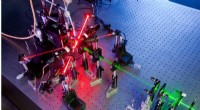
Optical devices play a major role in modern-day technologies and can be found in CD players, DVD players and fiber-optic cable boxes. Optical density and absorbance both measure the amount of light that is "absorbed" when passing through an optical component, but there is a subtle difference between the two terms.
Optical density is the amount of attenuation -- or gradual intensity loss -- that occurs when light passes through an optical component, such as a neutral density filter. Mathematically, optical density is equal to :
OD = Log (Power transmission factor)
For example, an optical density of 3 attenuates the light power by a factor of 10^3 (1,000). Optical attenuation may result from not only absorption of light but also from scattering of light. Absorbance considers only absorption within the optical component.