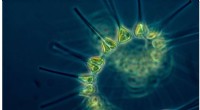
Humans fill the Earth, with a population of over 7 billion. Roundworms are more abundant animals, native even to Antarctica. However, microorganisms are ubiquitous. Microbiologists have located them almost everywhere on the planet. Finding microorganisms is not easy, since they must be seen with magnification. Bacteria, fungi and other single-celled organisms have been discovered in ordinary areas as well as in extreme locations.
Bacteria are extremely common microorganisms. Although they are known for causing serious diseases like pneumonia, meningitis and toxic shock syndrome, only 3 percent of bacteria are actively harmful to people or animals. The human body has about 100 trillion bacteria, with most living on the skin and inside the digestive system. Harmless bacteria on the skin protect themselves from other microbes by releasing toxic proteins. This not only keeps the bacteria safe; it prevents dangerous microbes from entering the human system. In the intestines, bacteria aid in digestion, access nutrients and hinder the growth of harmful bacteria.
In the late 1970s, scientists discovered that microorganisms once considered bacteria were actually a different life form: archaea. These organisms live in severe conditions where bacteria and animals are not found. For example, ocean-dwelling archaea live near vents where temperatures exceed 212 degrees Fahrenheit, the boiling point of water. Some live in hot springs, such as those found in Yellowstone National Park. Others survive deep in the Earth within oil deposits. Above ground, archaea live in the digestive systems of cows, where they produce methane.
To provide more evidence of ubiquity, some microorganisms -- endoliths -- are inside rocks or between grains of minerals. These bacteria, fungi or archaea are found both above and below the Earth’s surface. Because of their unique homes, some endoliths are autotrophs, making their own food from surrounding matter. One common endolith is a type of Antarctic lichen that grows inside sandstone. Deep-biosphere endoliths live miles below the ocean floor where temperature and pressure are severe and light and air are absent.
Not only are microorganisms in unique locations, they can also be found in the past. During the 1990s, bacterial spores were discovered inside the digestive system of bees trapped in amber, which is fossilized tree resin. The samples date back 30 million years. Researchers at California Polytechnic State University attempted to revive the bacteria and, over several years, repeated test after test to show the ancient bacteria were functioning again. However, some scientists questioned whether the samples became contaminated with modern-day bacteria.