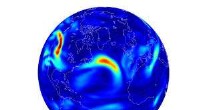
It’s not abstract art; it’s a weather map. Some weather maps have colorful blobs that give information about conditions in the air. When a large section of air has consistent temperature and humidity throughout, it’s an air mass. Meteorologists classify air masses by one of four “source regions” or locations of origin. These regions are usually large and flat with consistent formations, such as oceans or deserts.
Air masses at the Polar Regions form between 60 degrees latitude and the North or South Pole. Northern Canada and Siberia are common sources of these cold, dry masses, although they can also form over water. Because they are extremely dry, polar masses have few clouds. Meteorologists use a capital P to refer to these masses. Some resources differentiate between polar air masses and extremely cold ones that form very close to the poles. Arctic masses are abbreviated with an “A,” while Antarctic masses use “AA.”
Tropical air masses form within 25 degrees latitude of the equator. This means that the temperature will be warm or even hot. These masses, abbreviated with a “T,” can develop over land or water. Source regions include the Gulf of Mexico, southwestern United States and northern Mexico.
Continental air masses develop between 25 and 60 degrees latitude, either north or south of the equator. As indicated by their name, they form over large land areas, so they're dry. Since meteorologists consider this a secondary classification, it’s represented by a lower case “c.” When describing an air mass, meteorologists indicate both the humidity and temperature, in that order. For example, an air mass that originates over northern land is labeled “cP” for continental and polar regions. This air is dry and cold. A very dry and hot air mass that forms around the U.S. and Mexican border is labeled “cT” -- continental and tropical.
Air masses with high humidity form over oceans. This “maritime” classification corresponds to the same latitudes as continental masses. It is also considered a secondary category and is abbreviated “m.” Therefore, a humid, cold mass that develops over polar oceans is categorized as “mP.” This type of air mass impacts the U.S. west coast in winter. Humid and warm air masses often come from the Gulf of Mexico and southern Atlantic Ocean and are labeled “mT.” These have a strong effect on weather in the American southwest.