Food chains are feeding relationships between categories of organisms. They are fundamental concepts within the study of ecology. Understanding food chains helps you understand how energy flows in an ecosystem, and how pollutants accumulate. At the bottom of the food chain are producers, which are plants and algae that capture sunlight and carbon dioxide gas to make sugar. Next are plant-eaters, such as cows. Then meat-eaters, such as humans and bears, eat the plant-eaters. Lastly, decomposers, some of which are microscopic, break down all dead organisms into molecules.
At the beginning of the food chain are producers, or organisms that are photosynthetic. Photosynthesis is the conversion of light energy from the sun in order to fix atmospheric carbon dioxide gas into glucose, a sugar. On land, producers are plants. In the ocean, producers are microscopic algae. Life as we know it on Earth would not exist without producers, because animals in the higher food-chain categories must eat producers in order to get their source of organic carbon, or carbon that is digestible.
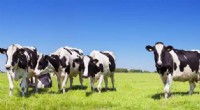
Primary consumers are herbivores, or organisms that eat plants, algae or fungi. Primary consumers are usually small rodents or insects that feed on plants. However, they can also be large animals such as baleen whales that filter out and feed on algae in the ocean. Humans can also be primary consumers, since we are omnivores, meaning we eat both plants and animals. Additional examples of primary consumers are caterpillars, rabbits, humming birds and cows.
Secondary consumers are carnivores, meaning they get energy by eating only herbivore animals. Some secondary consumers are frogs that eat insects, snakes that eat frogs, and foxes that eat rabbits. Tertiary consumers are carnivores that eat secondary consumers. Tertiary consumers are usually larger than their prey. Some examples of tertiary consumers are eagles that snakes, humans who eat alligators, and killer whales that eat seals. The accumulation of chemical pollutants has been documented to severely affect some tertiary consumers, such as the bald eagle. They consume many prey that have small amounts of a pollutant, so the chemical builds up in their bodies in high concentrations. Those that do not efficiently eliminate the chemicals from their systems suffer consequences. This magnification is called bioaccumulation.
Decomposers can range from microscopic organisms to large mushrooms. They feed on dead plants and animals. In this way, they consume all other organisms in the food chain. Decomposers include bacteria and fungi. One class of decomposers are called saprobes, which grow in decaying organic matter. An example of a saprobe is a mushroom that grows on a fallen tree. Decomposers serve a critical role in the ecosystem by breaking down organic matter into ammonia and phosphates, helping to recycle nitrogen and phosphorous into the nitrogen and phosphorous geochemical cycles, respectively.