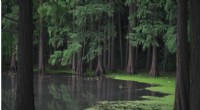
Primary producers, also called autotrophs, make up the foundation of the food chain of any ecosystem, including the tropical rain forest, because they produce their own food through photosynthesis and provide energy to other levels of the food chain. Photosynthesis occurs through a process involving sunlight, carbon dioxide and water. The tropical rain forests hosts more than 50 percent all the animal and plant species in the world. Some producers in the tropical rain forest include trees, algae and rattan.
Trees in the tropical rain forest make up a large population of primary producers. These trees include cecropia trees, strangler figs and ceiba trees. Cecropia trees are extremely common tropical rain forest trees that grow at an incredibly fast speed. They produce long fruits that transfer seeds through animal digestive tracts that end up at their newly fertilized growing area farther away from their parent tree than water or wind could have carried them. Strangler figs are found around the world across the equatorial zone. They attach their roots to a host tree and grow around and inside the host in order to acquire water and nutrients. Its name "strangler" is fitting, because by clinging onto its host it eventually kills it. There are 10 different species of the ceiba tree, and they are usually the tallest trees in a tropical rain forest, extending above the upper canopy. They have huge roots that are often exposed above ground. The most common species of ceiba tree is the kapok, which produces green seed pods packed with yellow fluff and hundreds of seeds.
Algae are the ancestors of all land plants of today. Simple cellular plants, they have no stems, roots or flowers. They are commonly found on the surfaces of bodies of water, though they are also found in tropical rain forests, particularly blue-green algae, because these environments are so moist and rich in nutrients. Small algae tend to grow as parasites below the cuticle of leaves on rain forest trees.
Rattan is a woody vine that grows up from the forest floor, using trees as support to reach the rain forest canopy to reach sunlight. Spines on their leaves help them climb up the trees. These vines can grow as high as 600 feet and be as wide as 1.5 inches. Rattan is used to make ropes, baskets and water-resistant wood furniture. In addition to growing in the wild in tropical rain forests, it is also grown in commercial farms for manufacturing purposes.
Detritivores are also at the base of the food pyramid, making it confusing as to the difference between producers and detritivores. Detritivores include fungi, viruses and bacteria. They feed on dead plants, insects and animals, in effect breaking them down and helping them decay into simpler forms so they can be recycled in the energy cycle. For example, a dead insect will be broken down by detritivores and incorporated into the soil that gives rise to the growth of a flower, which is a producer. Detritivores are thus an important link in the energy pyramid and play an important role by cleaning up the ecosystem.