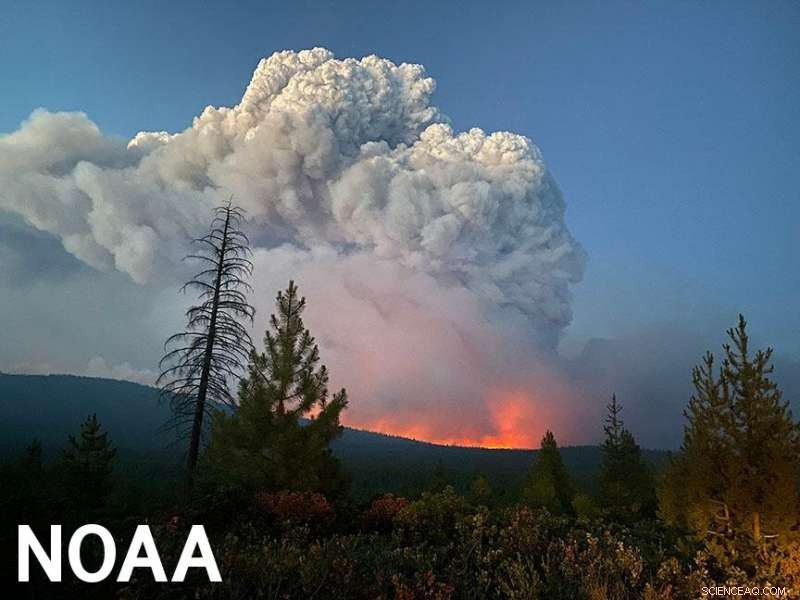
A fire cloud over the ridgeline rising from the Bootleg wildfire in Oregon, July 7, 2021. Credit: InciWeb/inciweb.nwcg.gov
July turned out to be an exceptional month of triple threats for the western U.S., with record heat, drought and raging wildfires. The nation as a whole had a hot July—with extreme rainfall in areas already saturated while sparing others that needed it most.
Here's a climate snapshot of the month of July and the year to date, according to scientists from NOAA's National Centers for Environmental Information:
Climate by the numbers, July 2021
The average temperature last month across the contiguous U.S. was 75.5 degrees F (1.9 degrees above average), placing July 2021 in the 13th-warmest spot in the 127-year record.
California, Nevada, Oregon and Washington had their hottest Julys on record. Five other states—Idaho, Montana, North Dakota, Utah and Wyoming—saw their top-10 hottest Julys.
The average precipitation for last month was 3.36 inches (0.58 of an inch above average), making it the sixth-wettest July on record. Precipitation was above average across much of the Northeast, Southeast and South, as well as portions of the Midwest, Ohio Valley and Great Lakes. New York and Massachusetts had their wettest July on record.
Meanwhile, much of the Northwest and Northern Tier, as well as parts of the central Plains, Midwest and central Appalachians, had below-average precipitation. Minnesota and Washington saw their second- and fourth-driest July on record, respectively.
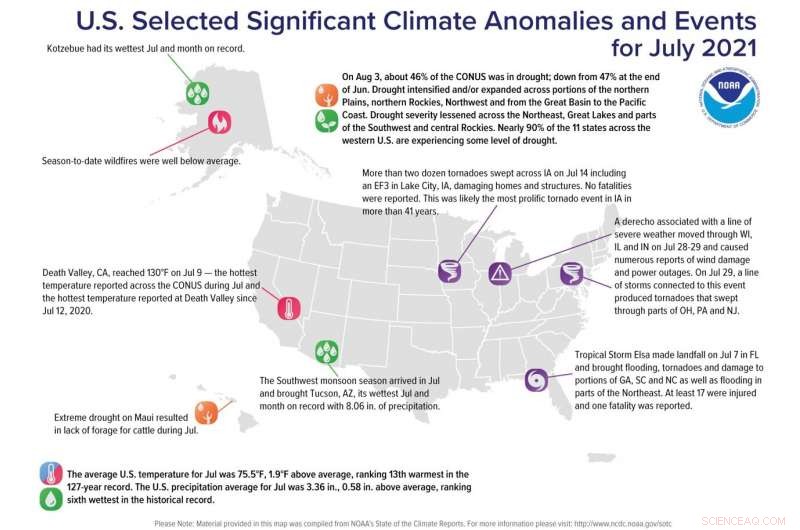
A map of the United States plotted with significant climate events that occurred during July 2021. Please see article text below as well as the full climate report highlights at http://bit.ly/USClimate202107. Credit: NOAA NCEI
Year to date | January through July 2021
The year-to-date (YTD) average temperature for the contiguous U.S. was 53.0 degrees F (1.8 degrees above the average), making it the 14th-warmest YTD on record. California, Nevada and Oregon each saw their warmest YTD.
The first seven months of 2021 saw an average precipitation of 18.00 inches (0.09 of an inch below average), which ranked in the middle third of the record. Mississippi had its sixth-wettest YTD, while Minnesota and North Dakota saw their third driest.
More notable climate events from the July report