Credit: CC0 Public Domain
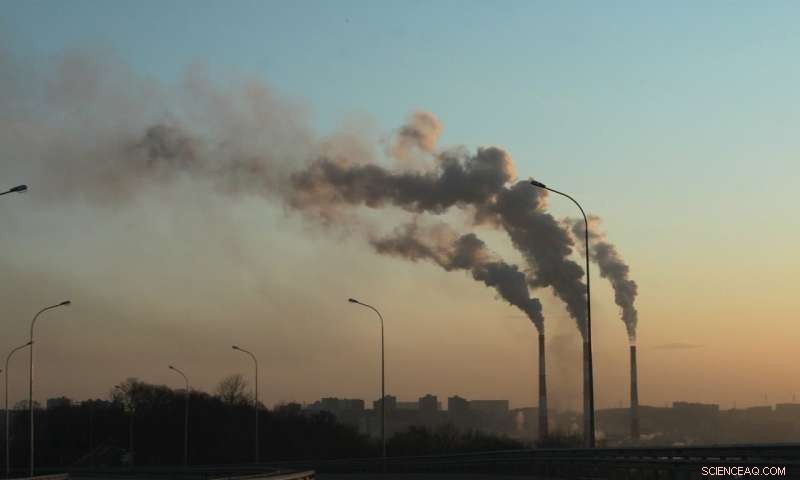
Electricity, transport, and heating account for a massive 80% of greenhouse gas emissions and are at the forefront of the battle to achieve Net Zero. However, reaching Net Zero means also dealing with the hard-to-reach 20% of emissions: agriculture, plastics, cement, and waste, and extracting at least 5% extra from the atmosphere to account for the emissions that we simply cannot get rid of. Together, this is known as the 'Final 25%'. And Net Zero cannot be achieved without tackling this hard-to-reach wedge.
Made up of a range of greenhouse gas emitters, which are harder to spot than pollution-belching-carbon-burning power stations, these emissions cannot be overcome by flipping a switch or buying a new car. But, combined, they account for one-in-four tonnes of greenhouse gases.
To investigate the problems and suggest policy pathways for new innovation, Oxford's Smith School of Enterprise and the Environment is today publishing findings from the 'Final 25%' project. The project called on the expertise of leading industry, investor, academic, civil society and policy minds to lay out roadmaps of investment to give us a fighting chance of meeting Net Zero with technology. These are contained in three keynote reports covering: the use of polymers; nature-based solutions for greenhouse gas removal; and alternative proteins.
Report author and the Director of Oxford's Smith School of Enterprise and the Environment, Professor Cameron Hepburn says, 'The Final 25% emissions identified in our three reports must be tackled if we are to achieve Net Zero. Reducing or eliminating them is going to mean some real changes, though, and significant investment is needed in R&D to make sure these can happen. We can do this and the novel and imaginative solutions contained in these reports could get us there.'
The reports considers a host of imaginative and sometimes challenging ways to tackle the Final 25%, including:
Leading report author, Dr. Katherine Collett, says, 'Mitigating climate change demands more than a shift to renewable electricity generation; investment in harder-to-abate sectors is already required.
'To reach Net Zero, intersections between plastics, proteins and plants, three seemingly unconnected systems, may hold the key. Our reports explore the potential of these systems in detail, pointing the way forward for research, policy development, regulation, and financing options.'
Brian O'Callaghan, Lead of Oxford's Economic Recovery Project and another report author, explains, 'In the shadow of COVID-19, government investment in green innovation can both help to constrain climate change and seed new industries to stand as powerhouses of economic growth in the long-term.'
Linking to past green investment programs, he continues, 'The US invested big in renewable energy research and development during the global financial crisis. That investment has delivered many multiples. Governments could make similar progress in agriculture and industry today.'
The Final 25% reports
Industrial need for carbon in products
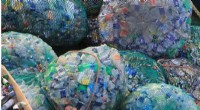
There is considerable international awareness about the problem of plastics in the environment. The report highlights that the need for petrochemical-based materials including polymers (plastics), asphalt, carbon fibre, pharmaceuticals, lubricants, solvents, and fertilisers, is not disappearing anytime soon. They are indispensable in modern economic and social systems. To reach Net Zero, new approaches are needed.
In particular, solutions are urgently required for manufacturing sustainable plastics, which are overwhelmingly produced with oil as a feedstock.
The report explains that research into sustainable feedstock alternatives needs to be accelerated, along with considering what will happen to the product at the end of its life: will it be recycled, biodegrade, or be buried? The report recommends:
The Climate Impact of Alternative Proteins
Animal products account for 16% of total greenhouse gas emissions, and this number is expected to grow to 35% by 2050 with increases in demand for animal products, driven by increased consumer wealth in emerging economies such as India and China.
The report recommends accelerated use of alternative sources of protein, including traditional plant-based proteins (e.g. tofu, nuts, peas, beans), insects, mycoproteins (e.g. products produced by Quorn), algae (e.g. spirulina), protein derived from bacteria, and cultured meat.
As well as the potential to produce Nearly Zero emissions, use of these alternatives means grazing land can be ecologically restored and provide natural greenhouse gas removal.
According to the experts, if these emissions are to be reduced, urgent research is needed into:
Nature-based 'sinks' for CO2 and sources of carbon feedstocks
Nature can be used as a carbon sink, removing emissions from the atmosphere (often called greenhouse gas removal), and as a source of carbon-heavy feedstocks, in the form of plants. Three main options are explored to understand how nature can fulfil these two roles. But further research is needed for these to be scaled up: