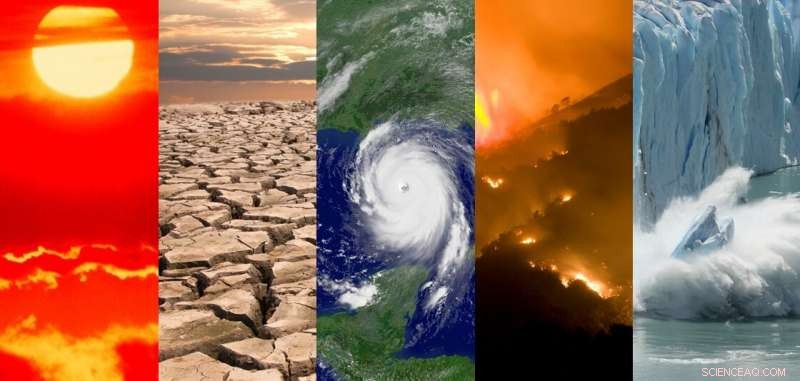
Credit: NOAA Headquarters
February 2021 was the planet's coolest February in seven years due to La Niña in the tropical Pacific Ocean and unusually brisk temperatures that enveloped much of North America and northern Asia.
But vast temperature contrasts during February—and during the three-month season—were at play in other parts of the world.
In fact, the Northern Hemisphere as a whole experienced its 8th-warmest winter (December through February) in 142 years, according to scientists at NOAA's National Centers for Environmental Information.
Here's more from NOAA's latest monthly global climate report:
Climate by the numbers
February 2021
The average global land and ocean surface temperature last month was 1.17 degrees F (0.65 of a degree C) above the 20th-century average making it the 16th-warmest February on record for the globe—but still the coolest since 2014.
It was the 14th-warmest February on record for the Northern Hemisphere and the 19th warmest for the Southern Hemisphere. Eastern Canada, much of Europe; and southern and northeastern Asia experienced remarkable warmth in February.
On the flipside, much of North America, Scandinavia and northern Asia saw much cooler-than-normal temperatures—at least 5.4 degrees F (3.0 degrees C) below average.
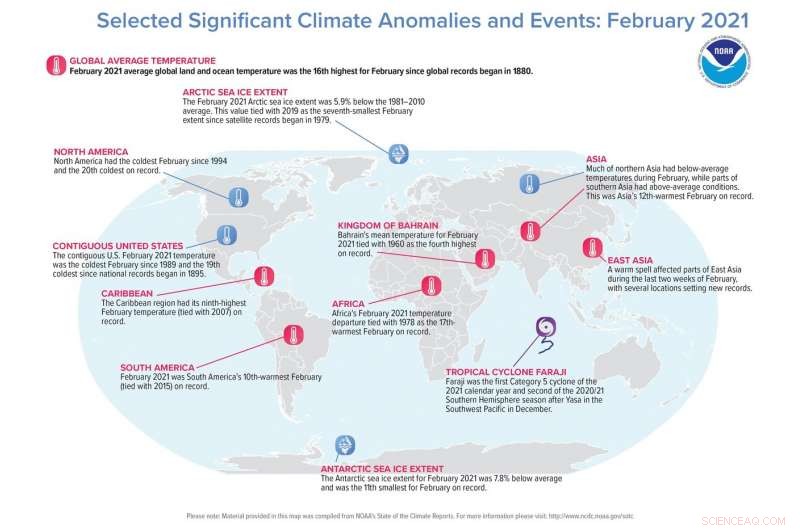
An annotated map of the world plotted with some of the most significant climate events that occurred during February 2021. Please see the story below as well as more details in the report summary from NOAA NCEI at http://bit.ly/Global202102. Credit: NOAA NCE
Seasonal statistics and the year to date
The three-month season (December through February) ranked 8th warmest on record for the globe. The Northern Hemisphere had its 8th-warmest winter, and at the other end of the planet, the Southern Hemisphere saw its 19th-warmest summer—one that tied with summers 1973 and 2009.
The 2021 year-to-date global land and ocean surface temperature logged in at 1.30 degrees F (0.72 of a degree C) above the 20th-century average, making it the 11th-warmest year to date (January through February) on record.
Other notable climate events in this report