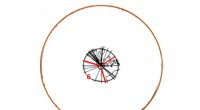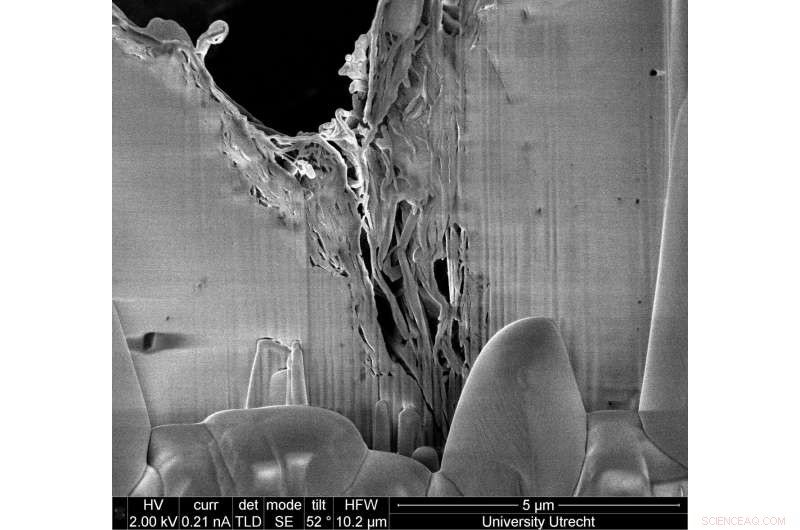
A sectioned quartz-quartz grain contact revealing a thin clay film (ribbon-like structure). Compaction and shear of these thin clay films has played a key role in controlling compaction of the Groningen gas reservoir to date. Credit: Microstructures were obtained by B.A. Verberne.
Europe's largest gas field, the Groningen field in the Netherlands, is widely known for induced subsidence and seismicity caused by gas pressure depletion and associated compaction of the sandstone reservoir. Whether compaction is elastic or partly inelastic, as implied by recent experiments, is key to forecasting system behavior and seismic hazard.
In their study published in Geology, Bart Verberne and colleagues sought evidence for a role of inelastic deformation through comparative microstructural analysis of unique drill-core, recovered from the seismogenic center of the field in 2015, 50 years after gas production started, versus core recovered before production (1965). Quartz grain fracturing, crack healing, and stress-induced Dauphiné twinning are equally developed in the 2015 and 1965 cores, with the only measurable effect of gas production being enhanced microcracking of sparse K-feldspar grains in the 2015 core.
Interpreting these grains as strain markers, Verberne and colleagues suggest that reservoir compaction involves elastic strain plus inelastic compression of weak clay films within grain contacts.
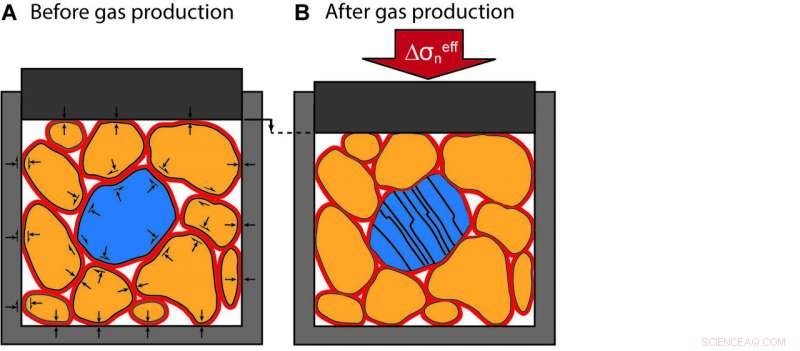
Idealized volume of reservoir sandstone undergoing vertical compaction with zero horizontal strain, typical of producing gas reservoirs. Note, in this simplification, all grain surfaces are coated with uniform clay films. In a real sandstone reservoir, clay films are discontinuous and locally absent, especially in distal regions of the field (orange--load-supporting quartz framework; blue--sparse feldspar grains; red--clay films). Credit: The conceptual model was developed by B.A. Verberne, S. Hangx, and C. Spiers.