
Lettuce rows. Credit: Kate Brauman from the University of Minnesota
In a new study published today in the Proceedings of the National Academy of Sciences, a research team co-led by the University of Minnesota, examined the risks to human well-being and prosperity stemming from ongoing environmental degradation.
"There are many ways that nature provides benefits to people—from the production of material goods to non-material benefits, and the benefits of natural ecology that regulate environmental conditions," said Kate Brauman, lead author and a lead scientist at the U of M Institute on the Environment (IonE). "We are in a much better position to identify the problems in the way we are managing nature, and that gives us a path forward to manage it better."
The study looked at a variety of peer-reviewed papers addressing wide-ranging elements of trends in nature and associated impacts on people. The study found that:
"This paper highlights the value of nature's contributions to our well-being," said co-author Steve Polasky, an IonE fellow and a professor in the College of Biological Sciences. "By making these values more visible, we hope that actions are taken to protect nature, so that nature can continue to provide benefits for future generations."
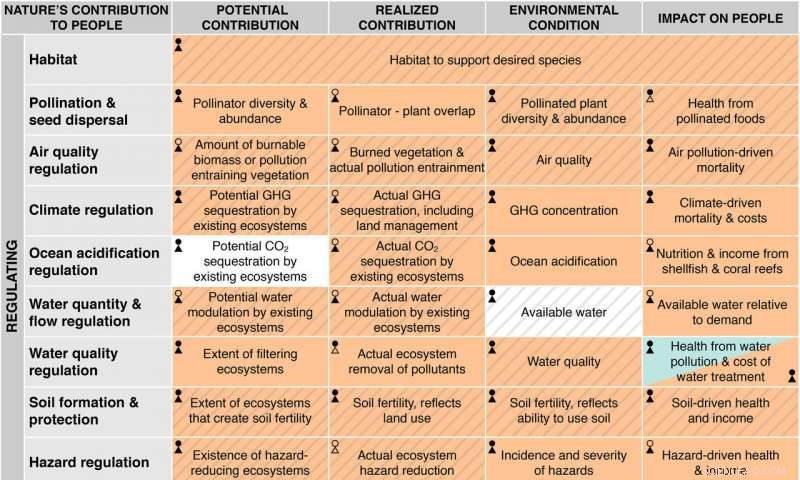
Study authors put together a table that catalogued the many ways that nature provides benefits, including the production of material goods and non-material benefits mentioned above, along with ecological processes that beneficially - and importantly - regulate environmental conditions, including water filtration, carbon sequestration, storm protection. Credit: Proceedings of the National Academy of Sciences