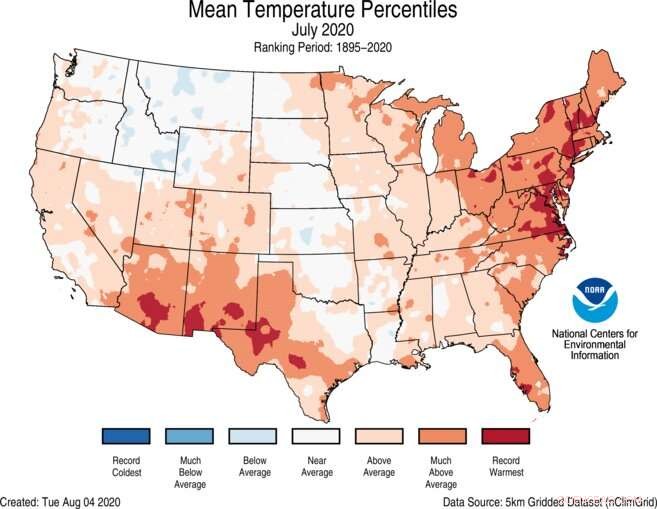
Credit: NOAA Headquarters
It was an unusually steamy month for the country—even for July. Some states recorded their hottest July ever as others tied with previous years.
The month's precipitation was also higher than average and ranked in the wettest third of the 126-year period of record, according to scientists from NOAA's National Centers for Environmental Information.
Not to be outdone, tropical activity in the Atlantic revved up, producing three tropical storms and two hurricanes in just July alone. They were the earliest fifth, sixth, seventh, eighth and ninth named storms on record in the Atlantic Basin.
Here's a climate snapshot of the month of July and the year to date:
Climate by the numbers
July 2020
The average temperature last month across the contiguous U.S. was 75.7 degrees F (2.1 degrees above average), making July the 11th-warmest in the 126-year record.
Seven states—Connecticut (tie), Delaware, Maryland, New Hampshire, New Jersey, Pennsylvania (tie), and Virginia (tie)—reported their hottest July on record. Fourteen more states across the South and East reported a top-10 hottest July.
The average precipitation for July was 2.93 inches (0.15 of an inch above average), which ranked in the wettest third of the record. Above-average precipitation fell across much of the northern and central Plains, as well as the Great Lakes, Mississippi Valley and Gulf Coast.
Year to date/January through July 2020
The year-to-date (YTD) average temperature for the contiguous U.S. was 53.6 degrees F, which is 2.4 degrees above the 20th-century average and the seventh warmest YTD on record.
In keeping with the warm trend noted in June's report, Florida saw its hottest YTD on record by July's end.
Precipitation was plentiful across the U.S. with a total of 19.29 inches—1.20 inches above average. The YTD ranked in the wettest third of the 126-year record, with both Tennessee and West Virginia marking their fifth-wettest.
More notable climate events