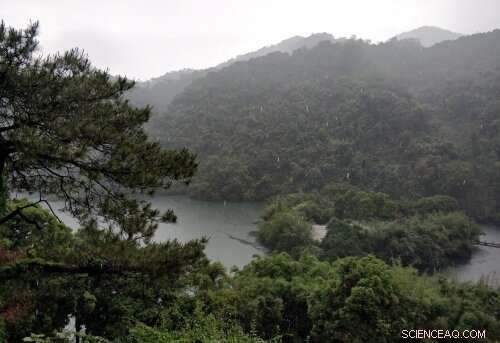
Rainfall in Xiamen on Aug 21, 2018. Credit: He Bian
Studies and simulations of global land precipitation and summer hemispheric precipitation have received much scientific and societal attention due to the impacts on economic development. Therefore, it is necessary to evaluate and improve the simulation capability of precipitation for models.
Recently, several modeling centers have released their Coupled Model Intercomparison Project Phase 6 (CMIP6) datasets. Taking the Global Monsoons Model Intercomparison Project (GMMIP) and historical experiments conducted by the Flexible Global Ocean-Atmosphere-Land System (FGOALS) climate system model, which was developed at the State Key Laboratory of Numerical Modeling for Atmospheric Sciences and Geophysical Fluid Dynamics (LASG), Institute of Atmospheric Physics (IAP), Chinese Academy of Sciences (CAS), as examples, the simulation performance for global precipitation and summer hemispheric precipitation are assessed in a recent study published in Atmospheric and Oceanic Science Letters.
"Previous studies have shown that the leading mode of global precipitation is ENSO-related rainfall with interannual variability, while the long-term trend is related to increasing temperatures. Therefore, the fidelity of different timescales should be considered," explains Dr. He from LASG/IAP. "For FGOALS-f3-L, the GMMIP simulation significantly exceeds the historical experiment on different timescales. Based on the difference of experimental design and the influence of SSTAs (sea surface temperature anomalies) on interannual precipitation, we explored the possible cause of the simulation discrepancy."
According to Dr. He's study, the simulation performance of sea surface temperature (SST) forcing affects the simulation performance for global precipitation significantly, especially the tropical Pacific SSTA. In addition, different regions respond differently to the Niño3.4 region SSTA and the ENSO effects are concentrated at low- to mid-latitudes.
"Realistic simulation of the SST field is necessary for CAS FGOALS-f3-L to capture the temporal characteristics of global and hemispheric land precipitation," concludes Dr. He.