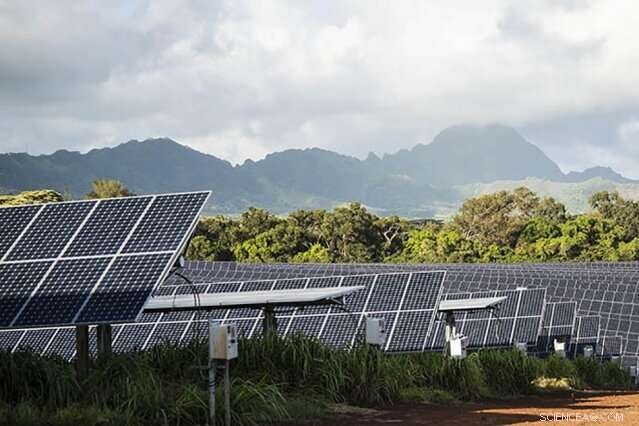
The AES Corporation, based in Virginia, installed the world’s largest solar-plus-storage system on the southern end of the Hawaiian island of Kauai. A scaled-down version was first tested at the National Renewable Energy Laboratory. Credit: Dennis Schroeder/NREL
When it comes to fulfilling ambitious energy and climate commitments, few nations successfully walk their talk. A case in point is the Paris Agreement initiated four years ago. Nearly 200 signatory nations submitted voluntary pledges to cut their contribution to the world's greenhouse gas emissions by 2030, but many are not on track to fulfill these pledges. Moreover, only a small number of countries are now pursuing climate policies consistent with keeping global warming well below 2 degrees Celsius, the long-term target recommended by the Intergovernmental Panel on Climate Change (IPCC).
This growing discrepancy between current policies and long-term targets—combined with uncertainty about individual nations' ability to fulfill their commitments due to administrative, technological, and cultural challenges—makes it increasingly difficult for scientists to project the future of the global energy system and its impact on the global climate. Nonetheless, these projections remain essential for decision-makers to assess the physical and financial risks of climate change and of efforts to transition to a low-carbon economy.
To that end, several expert groups continue to produce energy scenarios and analyze their implications for the climate. In a study in the journal Economics of Energy & Environmental Policy, Sergey Paltsev, deputy director of the MIT Joint Program on the Science and Policy of Global Change and a senior research scientist at the MIT Energy Initiative, collected projections of the global energy mix over the next two decades from several major energy-scenario producers. Aggregating results from scenarios developed by the MIT Joint Program, International Energy Agency, Shell, BP and ExxonMobil, and contrasting them with scenarios assessed by the IPCC that would be required to follow a pathway that limits global warming to 1.5 C, Paltsev arrived at three notable findings:
While the scenarios considered in this study project an increased share of renewables in the next 20 years, they do not indicate anything close to a complete decarbonization of the energy system during that time frame. To assess what happens beyond 2040, the study concludes that decision-makers should be drawing upon a range of projections of plausible futures, because the dominant technologies of the near term may not prevail over the long term.
"While energy projections are becoming more difficult because of the widening gulf between current policies and stated goals, they remain stakeholders' sharpest tool in assessing the near- and long-term physical and financial risks associated with climate change and the world's ongoing transition to a low-carbon energy system," says Paltsev. "Combining the results from multiple sources provides additional insight into the evolution of the global energy mix."
This story is republished courtesy of MIT News (web.mit.edu/newsoffice/), a popular site that covers news about MIT research, innovation and teaching.