Credit: CC0 Public Domain
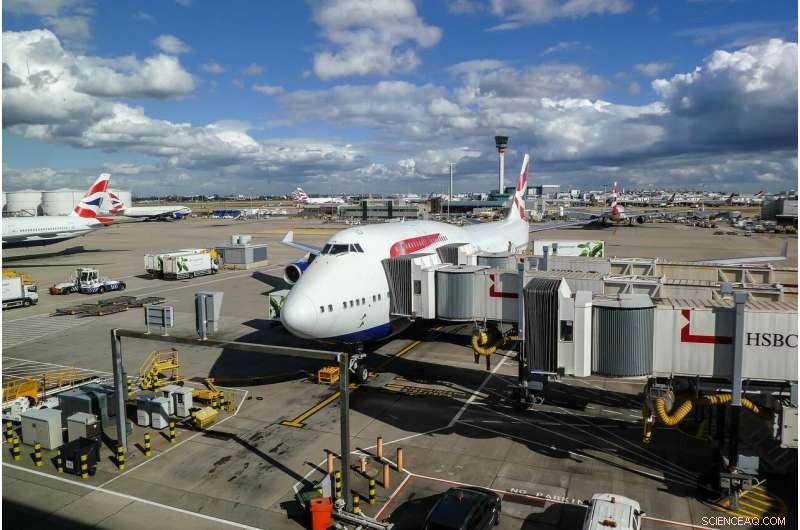
In a study published in Environment International researchers from King's have, for the first time, measured ultrafine particles (UFP) in European cities and detected emissions from airports.
Many studies have examined and quantified the levels of larger particles (e.g.PM2.5 - <2.5μm or PM10 - <10μm), however very few have studied UFP (< 0.1 μm).
In this study, researchers identified, characterized and quantified the sources UFPs in four European cities (Barcelona, Helsinki, London, and Zurich) between 2007 and 2017. They measured particle and gaseous pollutants at different sites and used a statistical model to identify and quantify the contribution of the different sources of ultrafine particles.
They found that:
Dr. Ioar Rivas, research fellow and author of the study said: "We expected traffic emissions to be an important source of ultrafine particles in cities but we now know that airport emissions, even if located at the outskirts of the city, can travel far enough and reach population on urban areas away from the airport".
Dr. Gary Fuller, senior lecturer in air pollution measurement, added: "Cities around Europe have policies to reduce airborne particle from the traffic that should also reduce people's exposure to ultrafine particles, but aircraft emissions are not being addressed in the same way".
The next steps in this research are to evaluate the effects of the different sources of ultrafine particles on mortality and hospital admissions.