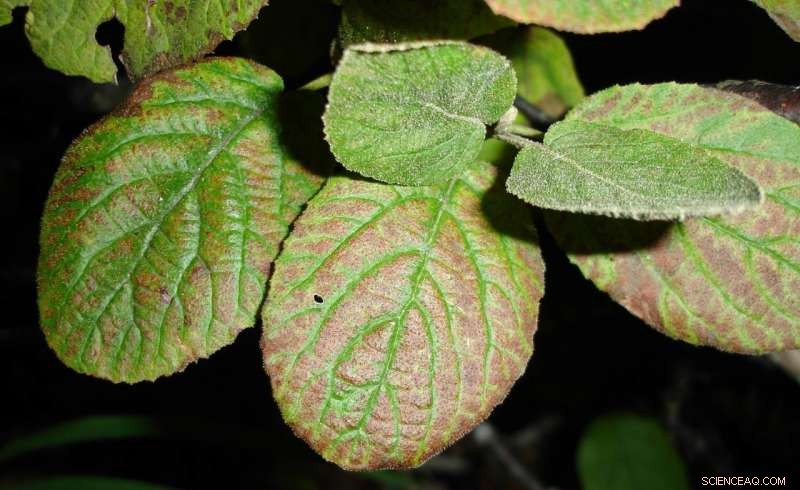
Leaves of the wayfaring tree (Viburnum lantana L) with visible ozone symptoms. Credit: Marcus Schaub, WSL
ICP Forests is a European-wide network of forest sites to study the effects of air pollutants on forests. Scientists have been measuring ozone concentrations since 2000 on 233 research sites in 18 countries and have observed a small but statistically significant decrease of mean summer concentrations. Southern Switzerland, however, remains one of the regions with the highest ozone levels in Europe; areas in Northern Europe are less affected.
The aggressive pollutant causes visible symptoms on leaves and needles on many sites of the ICP Forests monitoring network. The symptom development depends on the species and how well the trees are supplied with water, light and nutrients. Ozone may affect tree growth and water metabolism, and contributes to degradation of forests and their important services: these include provision of clean air and groundwater, timber for construction and energy, protection against natural hazards and of biodiversity.
WSL researchers summarize these results in ICP Forests Brief No. 3. Their key messages are: