Credit: CC0 Public Domain
The State of California today released California's Fourth Climate Change Assessment, which details new information on the impacts of climate change and provides planning tools to support the state's response.
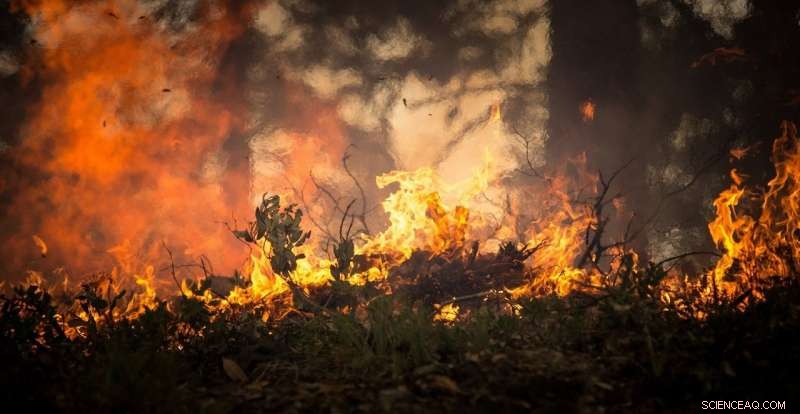
Among the assessment's warnings are that two-thirds of Southern California's beaches could completely disappear and the average area burned by wildfires could nearly double by 2100. Dan Cayan, a climate scientist at Scripps Institution of Oceanography at the University of California San Diego, served as editor-in-chief of the assessment and researchers from Scripps and California Sea Grant contributed to several of its technical and summary reports.
"To prepare for climate changes and to avoid possible catastrophic impacts, California needs a massive platter of scientific information," Cayan said. "The Assessment supplies such information in finer spatial detail and with greater attention to episodic events, illustrating an extensive set of changes that may confront us over the next several decades."
The compilation of original climate research includes 44 technical reports and 13 summary reports on climate change impacts to help ready the state for a future punctuated by severe wildfires, more frequent and longer droughts, rising sea levels, increased flooding, coastal erosion and extreme heat events. The peer-reviewed research translates global models into scaled-down, regionally-relevant reports to fill information gaps and support decisions at the local, regional and state levels.
"In California, facts and science still matter," said Governor Edmund G. Brown Jr. "These findings are profoundly serious and will continue to guide us as we confront the apocalyptic threat of irreversible climate change."
California has completed three prior Climate Change Assessments. Since the release of California's Third Climate Change Assessment in 2012, the state has experienced several of the most extreme natural events in its recorded history, including a severe five-year drought, an unprecedented tree mortality crisis, damaging floods driven by atmospheric rivers, and increasingly large and destructive wildfires.
The Fourth Assessment suggests these events will worsen in the future. Among the key findings:
The latest reports also detail the unique and disproportionate climate threats to vulnerable communities and tribal communities, with a focus on working collaboratively with these communities on research and solutions for resilience.
In addition, a report set for release in early September will highlight how California can better integrate climate impacts in design processes for critical infrastructure. The report by a working group established by AB 2800 (Quirk) of 2016 reflects the expertise of multiple scientific and engineering disciplines to help design and construct infrastructure to withstand higher temperatures, more frequent and intense storms, drought, wildfires and sea-level rise.
To access Fourth Assessment technical reports, summary reports, online tools, climate projects and data, and other resources and information developed as part of California's Fourth Climate Change Assessment, please visit ClimateAssessment.ca.gov.
California will convene the Global Climate Action Summit in San Francisco next month. At the summit, representatives from subnational governments, businesses and civil society will showcase the surge of climate action around the world, and make the case that even more must be done.