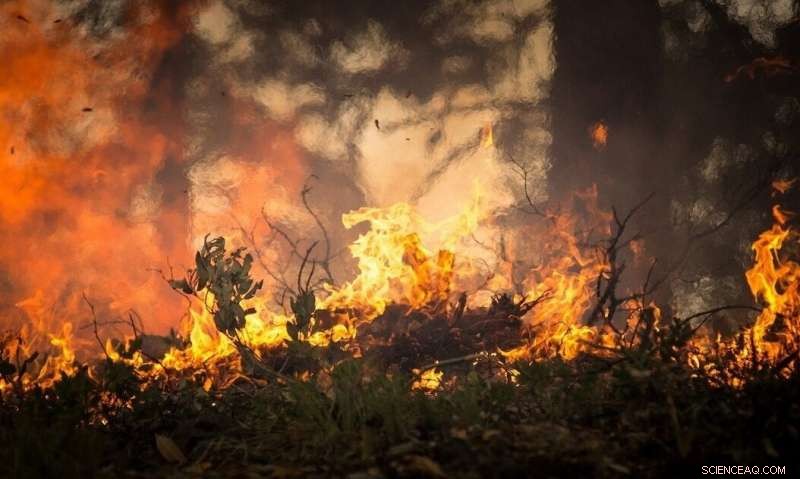
Credit: CC0 Public Domain
A team of researchers affiliated with several institutions in the U.S. has found that reduced rainfall in western parts of the U.S. may be playing a more important role than increased temperatures in spreading more and bigger wildfires. In their paper published in Proceedings of that National Academy of Sciences, the group describes their study of rainfall and fires in the area, and what they found.
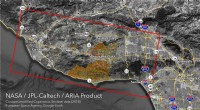
Wildfires in the western U.S. have been increasing in number and have been getting bigger over the past several years. Prior research has suggested that the primary reason for the change is an increase in temperatures in the region. In this new effort, the researchers wanted to know if changes in precipitation were also playing a role. To find out, they studied data collected from weather stations across the region for the years 1984 to 2015. They compared the data to satellite maps showing where wildfires had occurred and how big they had grown over the same time period.
Before conducting their analysis, the group proposed three main possible factors contributing to the increase and size of fires—that they were due to reduced snowpack, that they were due to higher temperature, or that they were due to lower rainfall.
Their first finding was that a reduction in snowpack was not a factor, either in the increase in fires or how big they grew. Their second finding was that there did seem to be a correlation between higher average temperatures in the area and the changes in wildfire patterns. Their third finding was that there appeared to be an even more pronounced correlation between declining amounts of summer precipitation and the number and size of wildfires. More specifically, they found that between 82 and 94 percent of the land area they surveyed experienced less summer rainfall over the time period they studied. They also found that the average forest in the area under study had 4 percent less rainfall per decade, and the worst of them had a 47 percent decline. They also found that the average number of days that rainfall exceeded 2.5 mm in the impacted areas fell, as well—and that the average length of dry spells increased.
The researchers suggest their data shows declines in rainfall in the western United States are a major factor causing an increase in the number of wildfires and how big they grow.
© 2018 Phys.org