Credit: CC0 Public Domain
An international team of researchers has found that there are few areas where palm oil cultivation could be undertaken in Africa that would not cause harm to native primates. In their paper published in Proceedings of the National Academy of Sciences, the group describes their study of data pertaining to the suitability of palm oil cultivation and primate vulnerability in Africa, and what they found.
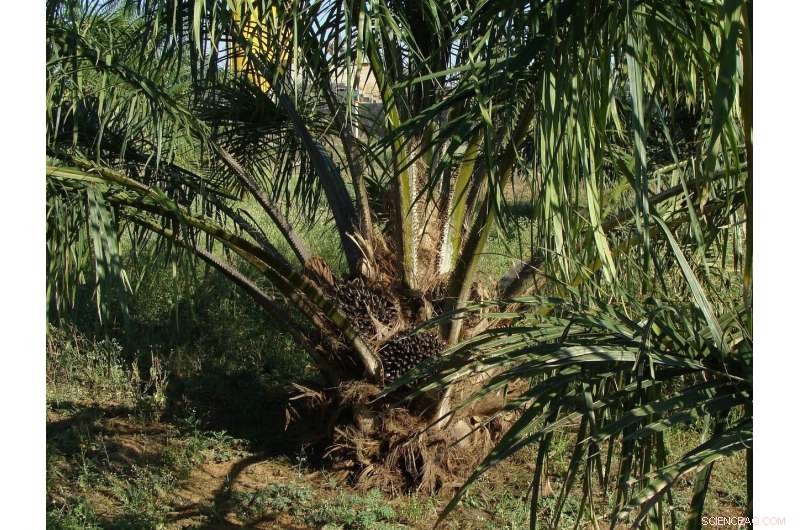
In recent years, palm oil has become more valuable. In addition to being used as a food additive (it is also in such products as cosmetics and soaps) it has now become an important ingredient it many biofuels. Palm oil comes, quite naturally, from the oil palm tree, which is native to West Africa. But it was migrated to Malaysia and Indonesia many years ago, and those two countries are now the main exporters of the oil. But that is likely to change, because land for growing the trees has become scarce in those countries. For that reason, producers have begun to take a serious look at establishing plantations in Africa. In this new effort, the researchers suggest that doing so will cause even more problems for at-risk native primate populations. The problem is that many of the primates living in Africa, inhabit areas that are most suitable for palm oil cultivation.
To learn more about the possible impact of palm oil cultivation in Africa, the researchers pulled statistics from databases containing information on palm oil production and primate vulnerability in Africa—comparing the two showed that there are very few places in Africa where palm oil could be cultivated without harming primates (it amounted to just 0.13 million hectares). One of the few exceptions was one part of Madagascar. They further note that there are almost 200 primate species living in Africa, and many of them are living in areas of overlap—land suitable for both primates and oil palm cultivation. They suggest that destroying habitat for the sake of palm oil cultivation would further endanger the primates living there. They further suggest that changes be made to palm oil cultivation practices to reduce the impact on the local environment. They also note that consumers can help by refusing to buy products that contain palm oil produced in ways that harm primates.
© 2018 Phys.org