Credit: CC0 Public Domain
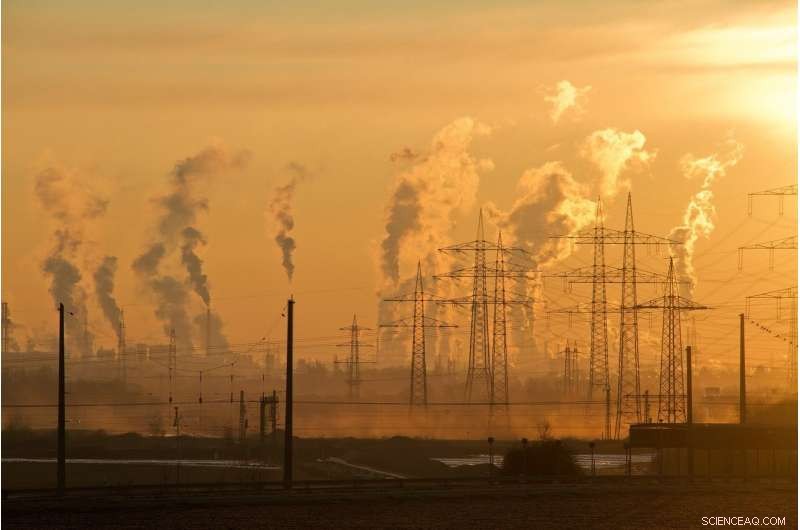
An international team of researchers has found that new particle formation (NPF) can occur in the atmosphere even in heavily polluted air. In their paper published in the journal Science, the group describes air quality testing they did in China over a period of years and what they found.
NPF occurs in the atmosphere when certain ingredients clump together spontaneously, causing the formation of new particles. Prior research has suggested that NPF only occurs in relatively pristine air, because particles in polluted air tend to scavenge precursors. In this new effort, the research team has found evidence indicating such conclusions are wrong—they have found evidence of NPF occurring in a heavily populated and polluted part of China.
The researchers explain that understanding NPF is important because of the impact it has on global warming. They note that NPFs can lead to cloud formation of a type that traps heat. To learn more about them and air pollution in China in general, they set up air quality monitoring stations in Shanghai and studied data from them covering the years 2014 to 2017.
In analyzing the chemistry of particles captured by the monitoring stations, the researchers found evidence of NPF precursor vapors and also large amounts of actual NPF clusters—this, despite the presence of large amounts of other particulates in the air. They suggest the NPF events came about due to sulfuric acid-dimethylamine-water nucleation which included sulfuric acid dimers.
To better understand how such clusters might form, the researchers entered their real-world data into a model and ran simulations to mimic conditions in the air over Shanghai and other large cities in China. They found that concentrations of sulfuric acid were sufficient to explain particle formation and growth during times of high condensation. They also found evidence that suggested larger cluster growth was likely due to the presence of other condensing organic species.
The researchers claim their study not only shows that NPF can occur in heavily polluted air, but that it is likely having a bigger impact on global warming than has been thought. They suggest climate change models will need to be changed to reflect what they have found.
© 2018 Phys.org