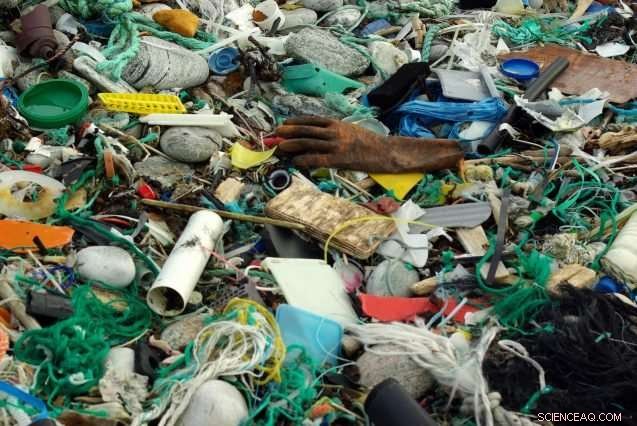
Marine litter. Credit: BoEide
Plastic permeates just about every aspect of our lives. And because plastic is everywhere, plastic pollution is also everywhere. Eight million metric tons of plastic waste enter the oceans each year, and it's estimated that by 2050, the amount of plastic in the ocean will weigh more than all the fish. Plastic ends up inside animals, too; a sperm whale that recently washed up in Spain had 64 pounds of plastic waste in its gut. Plastic is also polluting land, especially on farms where sewage sludge is used for fertilizer. Scientists found Bisphenol A (BPA), a chemical component in the plastic of some water bottles and the lining of tin cans, in the cord blood of nine out of 10 infants and in the urine of 95 percent of the adult Americans they tested. Tiny bits of microplastic and plastic fibers—smaller than the width of a human hair—have been found in honey, sugar, beer, processed foods, shellfish, salt, bottled water and tap water. Microplastics even contaminate Arctic ice in concentrations greater than those of the Great Pacific Garbage Patch—about 12,000 particles per liter of ice.
Last summer, Joaquim Goes, a research professor at Lamont Doherty Earth Observatory, and his team surveyed microplastics in the Hudson and East Rivers around New York City with the help of Riverkeeper. They discovered microplastics of all shapes and sizes in the water. The most polluted area was around Newtown Creek, where they could see waste drifting into the creek from the nearby sewage treatment plant.
"Most of our sewage treatment plants do not have the capacity to filter out these micron-sized particles of plastic," said Goes. "Because they get through the filtration system, they end up in the aquatic systems, and act like vectors for the transport of organic compounds [such as drugs and pesticides in the wastewater that ends up in sewage treatment plants]. When fish and shellfish take them up, you have a way by which microplastics get into food chain."
What scientists do not know, however, is what effects plastic and the chemicals within plastic might have on humans and other living things.
The plastic pollution problem can feel overwhelming, but there are actions we can all take to make a difference.
Don't use single-use plastics
This category includes plastic bags, straws, dry cleaning bags, water bottles, take out food containers, and coffee cups. Eight of the ten most common items in ocean trash are single-use food-related items, so whenever possible, bring your own reusable utensils and containers. For more suggestions, see 100 Steps to a Plastic-Free Life.
Be a conscientious consumer when you shop
Recycle, donate, repair
Put pressure on offenders and praise those who are reducing plastic use
If a company or manufacturer uses excessive plastic packaging, let it know. Write a letter or send a tweet. If you get no response, post it on social media. Conversely, praise businesses that are reducing their use of plastic by tagging the business and posting photos on social media. Tag @upstreampolicy, too, and Upstream, an organization fighting plastic pollution by advancing policies and corporate responsibility, will repost it.
Take a pledge to reduce your plastic use
Participate in cleanup efforts
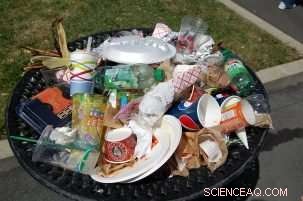
Credit: Kevin Krejci
Become an adventure scientist to help with research
Help gather data for the Worldwide Microplastics Initiative, which trains volunteers to collect marine and fresh water samples for scientists studying microplastics.
Organize a plastic pollution event
Support organizations that are fighting plastic pollution
Get politically active
Laws and social movements are the most effective means of changing consumer behavior on a large scale, so get involved with some of these issues.
Plastic bag ban laws
Countries around the world are phasing out the thin plastic bags given out in stores. Bangladesh, Rwanda, China, Taiwan, Macedonia, Gambia, Mali, Morocco, Niger, Tanzania and Sri Lanka and other countries have totally banned them. Many European Union countries impose a fee on plastic bags. And while there is no national ban or fee on bags in the U.S., California, American Samoa and Puerto Rico have banned plastic bags; more than 200 counties and municipalities have also banned bags or imposed fees for using them.
Attorney Jennie Romer founded PlasticBagLaws.org as a resource for cities, states and communities that want to institute plastic bag bans. Romer has found that hybrid bans are the most effective—those that ban thin plastic carryout bags and also impose a charge for paper or any other bags. She explained that with a straight bag ban that only outlaws the carryout plastic bag, consumers often switch to paper bags or thicker plastic bags that qualify as reusable. Even a small bag fee, however, dramatically changes consumer behavior and has resulted in an overall drop in bag consumption. For example, in San Jose, the hybrid ban model with a 10-cent charge for paper bags led to an increase in reusable bag use from 4 percent to 62 percent.
In April, Governor Cuomo proposed a plastic bag ban at all New York stores, but without a fee on paper or other bags. If approved, it would go into effect January 2019.
To propose a plastic bag ban in your community, check out Romer's primer on implementing plastic bag laws.
Expanded polystyrene bans
Some U.S. towns and cities have successfully banned non-recyclable and non-biodegradable expanded polystyrene (EPS), better known as Styrofoam, used in foodware and packaging. California, Florida, Maine, Maryland, Massachusetts, New Jersey, New York, Oregon, Texas, Washington and Washington D.C. have ordinances banning EPS. As of the beginning of 2017, there were 148 local ordinances against EPS in the U.S., with most found in California. Here is a guide for reducing EPS in your community.
Bottled water bans
Every year, 38 billion water bottles end up in U.S. landfills. Concord, Massachusetts banned the sale of bottled water in 2013. San Francisco has recently banned the sale of bottled water on municipal property and prohibited government agencies from buying it.
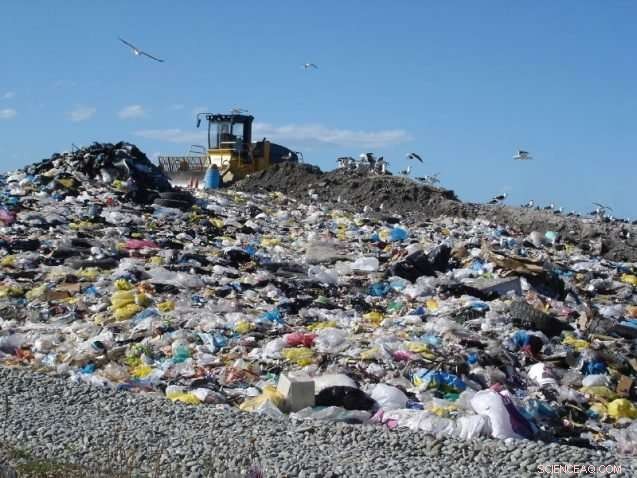
Plastic that is not recycled usually ends up in a landfill. Credit: Samuel Mann
The Ban the Bottle campaign has suggestions for starting a bottled water ban in your community.
Plastic straw bans
500 million straws are used each day in the U.S. Malibu, Miami Beach, San Luis Obispo, Fort Myers and numerous restaurants have stopped giving out straws unless customers specifically request them. As a result of the Strawless in Seattle campaign, Seattle too will ban straws in July, which could reduce straw use by a million a month. Inspired by Seattle, residents of Santa Fe are starting a Strawless Santa Fe campaign.
Surfrider's Straws Suck campaign encourages consumers to identify businesses that use straws by taking a photo of the plastic item and posting it to Twitter or Instagram with @SurfriderVan and hashtag #StrawsSuck or #RiseAbovePlastics.
Plastic-free restaurants
Surfrider Foundation's Ocean Friendly Restaurants campaign helps restaurants reduce their plastic consumption. Encourage your local restaurants to sign up.
Extended producer responsibility
Extended producer responsibility (EPR) legislation requires manufacturers to be responsible for the entire life cycle of their product, which means that discarded products must be taken back, recycled or reused to make new products. Producers themselves usually do not take back the products, however, but rather contract with third parties to deal with them.
Currently, U.S. taxpayers pay for local governments to deal with the collecting, recycling, and cleanup of plastic pollution. EPR would require manufacturers to pay for the amount of packaging they produce. These funds would then go to other entities to collect and recycle the items. This would help support and expand plastic recycling, and also encourage manufacturers to design more sustainable products.
All European Union members have some form of EPR legislation on packaging, as do Poland, Hungary, the Czech Republic, Japan, Korea and Taiwan. In the U.S., there are no state or federal EPR laws for packaging, though there are some state and municipal EPR laws for other product categories. Upstream provides information about EPR legislation.
The organization is also developing a Global Plastic Reduction Toolkit that will be a resource for proposing, passing and implementing legislation to regulate or restrict single-use plastics, highlighting successful examples in cities, states, and countries around the world.
Leading the change
British prime minister Theresa May has proposed a ban on all single-use plastic items in the U.K., including straws and cotton swabs, by early 2019. Iceland Foods, a British supermarket chain specializing in frozen foods, has promised to do away with plastic packaging for its own brand by the end of 2023, and instead use recyclable paper or pulp packaging.
Ekoplaza, a Dutch supermarket chain, has created the first plastic-free supermarket aisle with 700 items that use no plastic packaging. The products carry the Plastic Free Mark, a new label that enables consumers to more easily choose plastic-free products. The products will be packaged in compostable bio-materials, cardboard, glass and metal.
A Scottish company called MacRebur is testing a road made from recycled plastic, which it claims is stronger and more durable than asphalt roads. The company maintains the road can also boost fuel economy because there is less tire resistance.
On the promising research front, the University of Portsmouth in the U.K. along with the U.S. Department of Energy's National Renewable Energy Laboratory have (accidentally) engineered an enzyme that can "eat" polyethylene terephthalate (PET), the plastic used in water bottles. The discovery could make it possible to recycle much more plastic waste.
If you are feeling discouraged by the scale of the plastic pollution problem, Jennie Romer has some advice. "Don't beat yourself up too much or get overwhelmed," she said. "Plastics are part of life. But figure out where you can cut plastic out of your life and find others who are also interested in advocacy to build a coalition. The issue can be taken on at the grassroots level."
This story is republished courtesy of Earth Institute, Columbia University http://blogs.ei.columbia.edu.