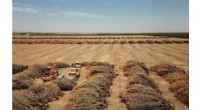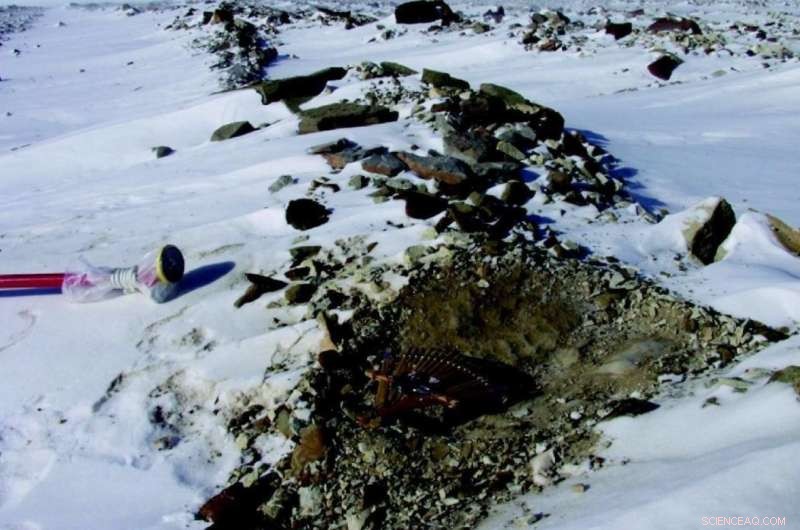
The sampling area at Larkman Nunatak. Credit: Imperial College London
Imperial experts have found a 'breadcrumb trail' of debris from an 800,000 year old meteor impact
Around 800,000 years ago, a 20 kilometre meteor collided with the earth, producing a zone of debris in Australasia which covers a tenth of the Earth's surface.
However, despite the impact's relatively young age in geological terms, and the meteor's size, the resulting crater's location eludes us.
It's a mystery. If a relatively young, 20 kilometre-wide crater can escape detection, how do we find impact craters that are many millions of years old?
Earth scientists Dr. Matthew Genge from Imperial College London and Dr. Matthias Van Ginneken from Vrije University in Belgium are on a mission to find the impact site.
Dr. Genge, from Imperial's Department of Earth Science & Engineering, said: "It's a mystery. If a relatively young, 20 kilometre-wide crater can escape detection, how do we find impact craters that are many millions of years old? And what hope do we have of predicting future collisions if older craters can just disappear?"
Cosmic crumb trail
Scientists have already found debris from the collision, in the form of glassy 'beads' a centimetre in diameter known as tektites, scattered from Australia to Vietnam.
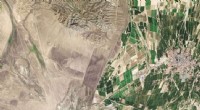
Following impact debris could help experts find mysterious crater. Credit: Imperial College London
The tektites are thought to begin as molten spray from the impact, and have settled over an area of more than 150 million square kilometres.
Now, Dr. Genge and Dr. Van Ginneken have found smaller versions from the same impact, called microtektites, as far south as Antarctica. They uncovered the tiny round structures, which are the width of a human hair, in the Larkman Nunatak in Antarctica's Grosvenor Mountains.
Dr. Genge said: "We found tiny yellow glass spherules within glacial debris in Antarctica, and our analysis of potassium and sodium suggests that these were thrown the farthest from the impact crater."
Far-flung?
During and after an impact, levels of potassium and sodium in the resulting debris drop as they travel. The hottest debris end up farthest away, and end up carrying lower levels of potassium and sodium, which provides a 'fossil compass' that points to the area of impact.
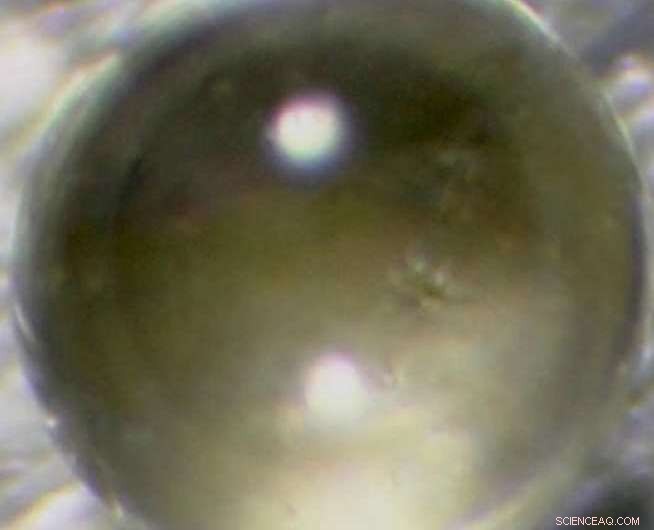
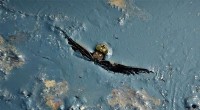
A microtektite from Larkman Nunatak. It is the width of a human hair. Credit: Imperial College London
Dr. Van Ginneken explained: "There are some significant differences between the Antarctic microtektites and the larger tektites found closer to the impact site in Australasia. The microtektites contain less sodium and potassium, which are easily lost under hot conditions. Our microtektites appear to have been hotter, which means they are furthest from the initial impact.
"Following the breadcrumb trail of debris from hotter to cooler should lead us to the crater."
Finding hotter debris furthest from the collision site seems counter-intuitive, but Dr. Genge says this effect is to be expected.
He explained: "Imagine an asteroid several kilometres wide hitting the ground at a speed of ten kilometres per second. Initially, all that energy is focused at the point that the asteroid first touches the ground, which vaporises the rock. The energy then moves outwards and weakens melting rock as it spreads."
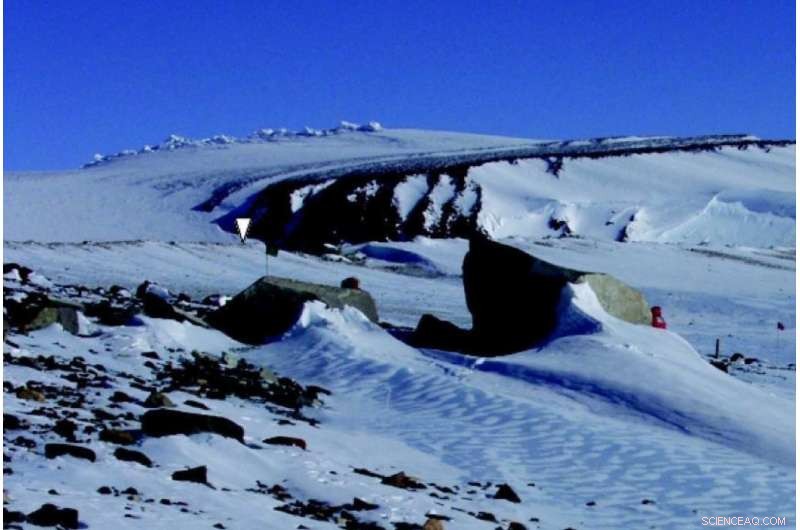
Larkman Nunatak. Arrow indicates where the microtektites were collected. Credit: Imperial College London
Collision course
Meteors crash into Earth more often than one might think and yet, despite their sometimes catastrophic effects, their remains can be difficult to detect. Yet the experts' discovery has more significance than just one mysterious impact years ago—it might help them find other missing craters.
Dr. Genge and Dr. Van Ginneken believe their technique of testing levels of potassium and sodium among tektites and microtektites could help them trace more ancient impacts. Dr. Genge said: "Tiny impact debris are scattered over most of the globe, and are probably offering clues that we haven't tapped into yet."
Nonetheless, they say this is the best evidence yet that the collision occurred 800,000 years ago – but the ultimate proof lies in finding the crater itself. The team hopes these tiny new clues will help lead the way.