Credit: CC0 Public Domain
A small team of researchers from the U.K and France has found evidence indicating that Sicily's Mt. Etna is sliding very slowly downhill toward the sea. In their paper published in Bulletin of Volcanology, the group describes their 11-year study of the volcano and the evidence they found for its movement.
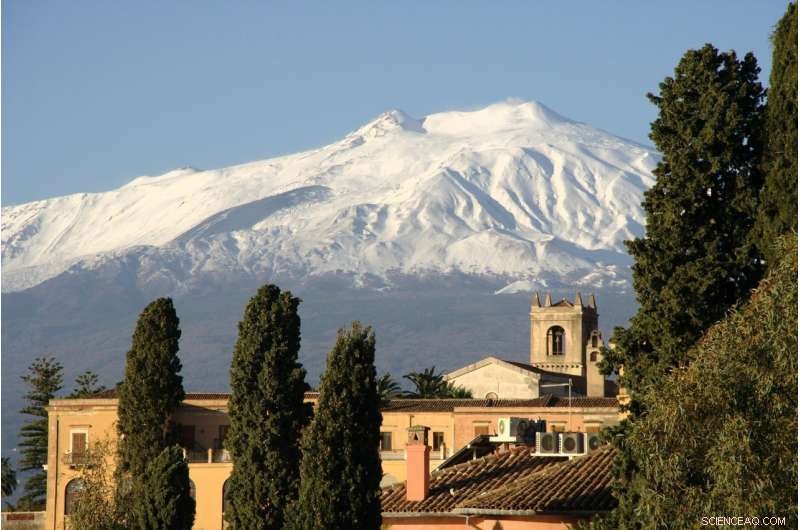
Mt. Etna is, of course, Europe's most active volcano. It is situated on the eastern part of the island of Sicily and has erupted approximately 200 times since 1500 BC—the date of the oldest recorded eruption. It was last seen erupting last year. The volcano has been the subject of study for lead investigator John Murry for nearly a half-century. As part of his research, he has worked with teams that contributed to installing very precise GPS devices at sites around and on the mountain. Data from those devices allowed the current team to note that the mountain has been moving. Over the past 11 years, they report, the mountain moved an average of 14 mm per year. It is moving because it is situated on a base of loose sediment on a slope of approximately one to three degrees. Furthermore, it is moving in an east-south-east direction towards the town of Giarre, though it will take some time to get there—the town is approximately 15 km distant from the mountain.
Such movement by a volcano is known in the field as basement sliding. The team reports that their observations of Mt. Etna's sliding are the first ever for an entire active volcano. They report also that the movement they noted is not an imminent threat to people in the vicinity, but they do suggest it should be taken into account in the future. Prior research by other teams has shown that volcanos that move can suffer massive failure as the part of the mountain in front eventually gives way under pressure. More importantly, monitoring of the mountain for tell-tale signs of an imminent eruption need account for the movement of the mountain to offer reasonably accurate estimates of volcanic activity.
© 2018 Phys.org