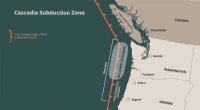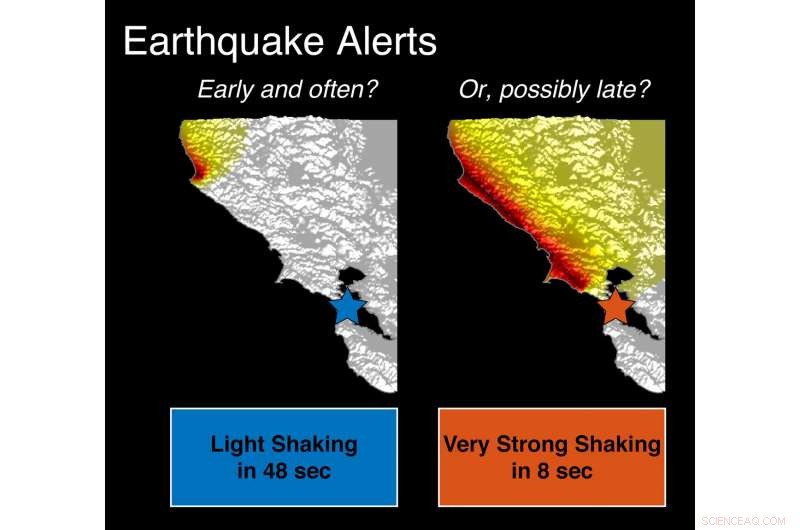
We have a choice when issuing earthquake warnings: 1) issue alerts for weak shaking and potentially provide long warning times, but also send alerts for many events that do not go on to produce strong ground shaking, or 2) issue alerts only when ground shaking is expected to be damaging and risk the alerts being too late. Credit: Sarah Minson, Elizabeth Cochran, U.S. Geological Survey
A team of researchers with the U.S. Geological Survey and the California Institute of Technology has found that modern earthquake early warning (EEW) systems require those interpreting their messages to take into consideration inherent tradeoffs. In their paper published on the open access site Science Advances, the group describes their study of EEW systems, what they found and offer suggestions regarding how to interpret warnings from such systems.
Because no one has figured out a way to predict earthquakes, scientists and public officials have turned to EEWs as a means of offering the public some degree of warning that an earthquake is about to occur. Unfortunately, the science in this area is still weak because earthquakes are so unpredictable. The main problem is that in the first few seconds of an earthquake, there is no indication of how big it will turn out to be. This means that if an EEW sends out an alarm every time it detects a quake, the public will get warnings for quakes they need not fear most of the time.
Another consideration is distance—if the epicenter of a quake is right under your feet, there is no EEW that can help you, because it will only tell you what you already know. EEW systems are meant for cases in which the epicenter is some distance from a populated area—if a quake happens 100 miles away, it will take some time for the ground to shake locally. So, how are public officials or the public at large to interpret warnings from such systems? That is what the team with this new effort sought to better understand.
To learn more about EEWs, the researchers looked at data from past earthquakes and applied math propagation formulas to calculate how much time EEWs have to issue an alert under different scenarios, and from that, how much time those people receiving such alerts would have to react. They found that in most cases, there is a tradeoff for those attempting to figure out if they should take defensive action or not. Users can receive alerts with longer or shorter warning times, but the problem is that longer warning times are far less informative—shorter warning times offer a better indicator of how bad an earthquake is going to be, but they offer very little time to do anything about it.
© 2018 Phys.org