Credit: NOAA Headquarters
Though La Nina is starting to wane, the ocean-cooling phenomenon continues to lower global temperatures.
February 2018 ended up being Earth's coolest February in four years. The December-to-February seasonal period also was the coldest it has been since 2014, according to scientists from NOAA's National Centers for Environmental Information.
Let's take a closer look at NOAA's monthly analysis, which shows how Earth fared for the month, the three-month season and the year to date:
Climate by the numbers
February 2018
The average global temperature in February 2018 was 1.17 degrees F above the 20th-century average of 53.9 degrees. This was the 11th highest for February in the 139-year record (1880-2018). February 2018 was the 42nd consecutive February and the 398th consecutive month with temperatures above the 20th-century average.
Seasonal | December 2017 through February 2018
The end of February marked the end of the meteorological winter for the Northern Hemisphere and summer for the Southern Hemisphere. The average seasonal temperature for the globe was 1.31 degrees F above the 20th-century average of 53.8 degrees, and it was the fifth warmest for December-February in the record.
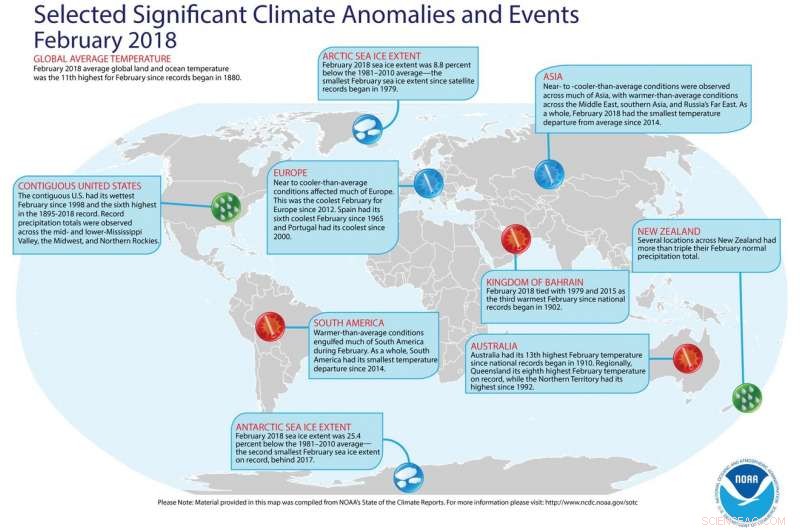
An annotated map of the globe showing other notable climate events that occurred during February and Winter 2018. For details, see bulleted list below in our story and also visit https://www.ncei.noaa.gov/news/global-climate-201802. Credit: NOAA NCEI
Year to date | January through February 2018
The year-to-date average global temperature was 1.22 degrees F above the 20th-century average of 53.8 degrees. This was the eighth-highest temperature for the year to date period on record and the coolest such period since 2014.
Other notable climate events and facts
Near-record-low sea ice at the poles
Warmer-than-average lands and oceans
Oceania led the continents in warmth rankings