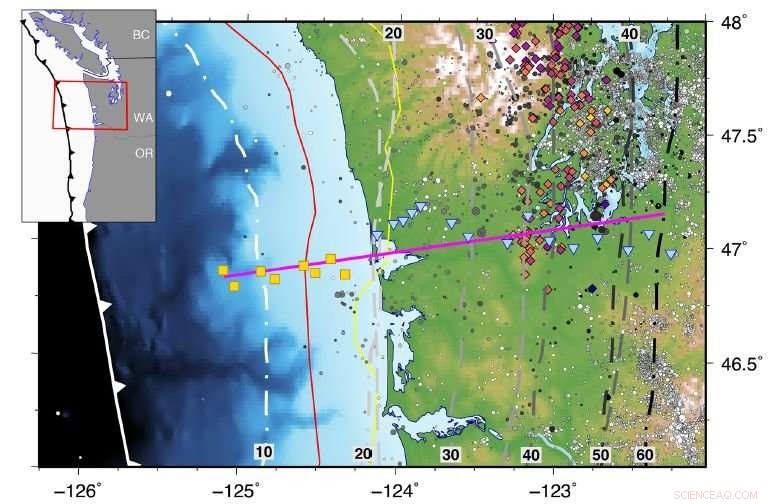
Map of the Cascadia forearc region. Credit: Science Advances (2018). DOI: 10.1126/sciadv.aar2982
A team of researchers with the University of Ottawa has used teleseismic data from on- and off-shore sensors to learn more about the low-viscosity layer (LVL) present in a northern part of the Cascadia subduction zone. In their paper published on the open access site Science Advances, the team reports on what they learned.
A tectonic plate originating beneath the Pacific Ocean (off the northwest coast of the U.S. and southwest part of Canada) is slowly being pushed under the North American plate, forming the Cascadia subduction zone. Because of the instability in the area, earthquakes occur. But there has not been a major quake in the region since 1700, making geologists nervous as they try to predict when the next one might be. Complicating this work is a relative lack of seismic activity in the seismogenic zone. In this new effort, the researchers took a new approach to studying the zone—they used teleseismic data from sensors both onshore and offshore to study the low-viscosity layer.
An LVL is a part of the subduction zone containing fluids that have been released from a subducting oceanic plate. Researchers study LVLs because they offer a means for studying subduction zones without using data from the seismogenic zone—seismic waves travel through them more slowly than other parts of the zone. The new teleseismic data offered a new perspective on the LVL that exists in the northern part of the Cascadia subduction zone. The researchers were able to see that the LVL does not extend into the locked zone, which is actually a good thing. Its presence would likely buffer Portland and Seattle during a major shift, resulting in less of an earthquake impact. The placement of the LVL, the team reports, is somewhat of a surprise, but it also helps explain a previously puzzling gap between the edges of the fault zone. The researchers also found that the LVL is very thick in the deeper parts of the interface between the two plates, suggesting it is well developed.
© 2018 Phys.org