Credit: European Commission Joint Research Centre
2017 was one of the worst years on record for fires in Europe, with over 800,000 hectares of land burnt in Portugal, Italy and Spain alone.
As the world gets warmer and Europe's land gets drier, fires are set to get even worse - and not just for the hottest countries around the Mediterranean. Even relatively safe Alpine mountain regions will see a rapid increase in fire danger unless action is taken to limit climate change and reduce the main causes for wildfires starting and spreading.
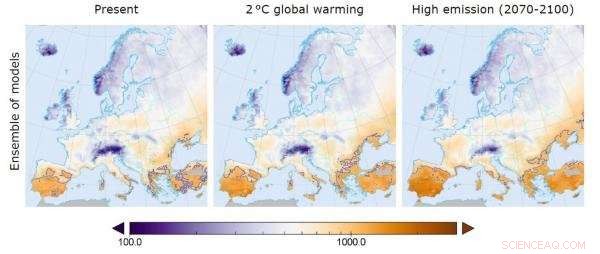
These warnings come from a JRC study of factors affecting fire danger across the continent. Scientists modelled fire danger for several weather and climate scenarios. The study compares a high greenhouse gas emissions scenario to one in which global warming is limited to 2°C above pre-industrial levels, run across several models to assess patterns of danger up to the end of the century.
The effect of climate change on rainfall, temperature, wind and humidity will cause countries around the Mediterranean to become drier. By drawing moisture from deep layers of wood, leaves, soil and other organic matter, extreme weather events such as droughts could leave kindling waiting to ignite. The dryness is set to push northwards to central Europe, putting a larger area at risk. Land surrounding the Alps and other European mountain systems, in which wildfires are currently much less common, show a fast pace of danger increase.
Successful action to limit the level of global warming can prevent the situation from spiralling out of control, although the danger is set to increase even in the most optimistic climate scenario. This means that effective adaptation strategies will be crucial to minimising the severity and occurrence of forest fires - and the havoc that they can wreak on European communities.
The study identifies three key factors that could help reduce the risk:
Europe's increasingly urbanised population further highlights the importance of minimising fire risk. As the world becomes more urbanised, abandoned agricultural land could leave behind more fuel to feed wildfires. This exposes new settlements built in transitional areas between cities and wildland to increased fire risk. Hence, careful landscape design must also frame strategic agricultural land use planning, with the aim to avoid the abandonment of agricultural land.
The report argues that, as well as taking account of these factors, policymakers should look at wildfires as a natural hazard and consider designing defensible space from a social and policy perspective.
In reponse to the 2017 forest fires, the Commission has taken a number of iniatives to further strengthen EU civil protection capacity and to enhance disaster prevention, preparedness and response across Europe. For instance, the Commission proposal to amend the Union Civil Protection Mechanism, published last November, aims to reinforce overall collective capacities to respond to disasters, and to strengthen the focus on prevention.