Credit: NOAA Headquarters
With a warm start to the year and only one month remaining, the globe remains on track to go down as the third warmest year in the 138-year climate record.
So let's get straight to the data and dive deeper into NOAA's monthly analysis to see how the planet fared for November, the season and the year to date:
Climate by the numbers
November 2017
The average global temperature in November 2017 was 1.35 degrees F above the 20th-century average of 55.2 degrees, according to scientists from NOAA's National Centers for Environmental Information. This average temperature tied 2016 as the fifth highest for November in the 1880-2017 record. This marked the 41st consecutive November and the 395rd consecutive month with temperatures above the 20th-century average.
Seasonal | September through November 2017
The end of November marks the end of the fall season for the Northern Hemisphere and spring for the Southern Hemisphere. The average seasonal temperature for the globe was 1.35 degrees F above the 20th century average of 57.1 degrees F. This was the fourth highest for September-November in the 1880-2017 record.
Year to date | January through November 2017
The year-to-date average temperature was 1.51 degrees F above the 20th-century average of 57.2 degrees. This was the third warmest for this period on record.
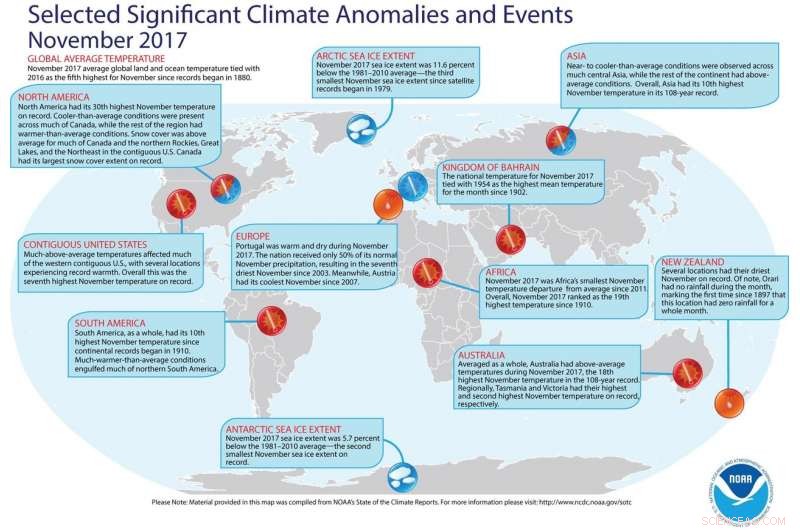
These are some of the noteworthy climate-related events that occurred around the world during November and the year to date. Credit: NOAA NCEI
Other notable climate events and facts around the world last month included:
Near-record-low sea ice at the poles
Warmer-than-average lands and oceans
South America and Asia led the continents in November, seasonal warmth rankings