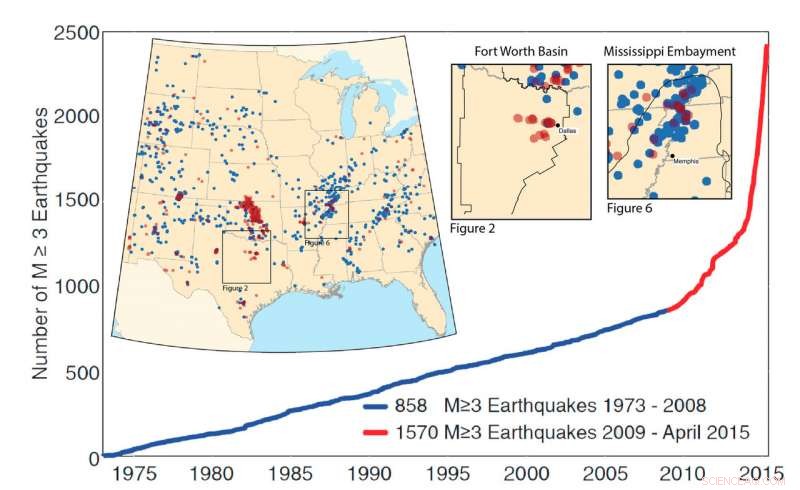
Post-2008 seismicity rate change in the central United States. Since 2009, seismicity has occurred both in areas that were seismically active before 2008 (for example, the Mississippi embayment) and in regions with no pre-2008 historical or instrumental seismicity (for example, the Fort Worth Basin). Credit: Magnani et al., Sci. Adv. 2017;3: e1701593
(Phys.org)—A team of researchers with Southern Methodist University in Texas and the U.S. Geological Survey Earthquake Hazard Program in Virginia has taken a new approach to studying the increase of earthquakes in Texas. In their paper published on the open access site Science Advances, the group suggests their findings indicate that the wastewater injection process is the only possible cause of a recent uptick in earthquakes around the Fort Worth area.
Fracking, extracting natural gas using hydraulic fracturing, and other techniques, have been in the news a lot of late. On the one hand, it has been credited with helping the U.S. become less dependent on foreign oil. But on the other hand, more studies are finding that in addition to harming the environment, the practice appears to be causing small earthquakes. It should be noted that it is not the actual fracking that is believed to cause earthquakes, it is the practice of forcing the dirty water left over from the process back into the ground afterwards that appears to cause the problems—it loosens material around underground faults.
There is little doubt that more earthquakes have been occurring in parts of the U.S. since fracking began, but less certain is whether fracking is the cause. The strongest proof to date has been the location of the upswing in small earthquakes around areas where fracking is conducted. In this new effort, the researchers sought to take a more scientific approach to settling the matter—they used the same technology that the oil companies use to find underground deposits of oil and gas—high-resolution seismic reflection imaging. But instead of looking for oil or gas, the researchers looked for deformed faults beneath the ground in the Forth Worth basin. They compared seismic readings in Texas with those from sites in a northern part of Mississippi with a history of small quakes going back to the 1800s, well before fracking began.
The researchers report that their readings showed that the most recent natural fault activity beneath the Fort Worth basin was approximately 70 million years ago. That meant that the team was unable to find any natural cause for the recent quakes, leaving fracking as the only possible culprit.
© 2017 Phys.org