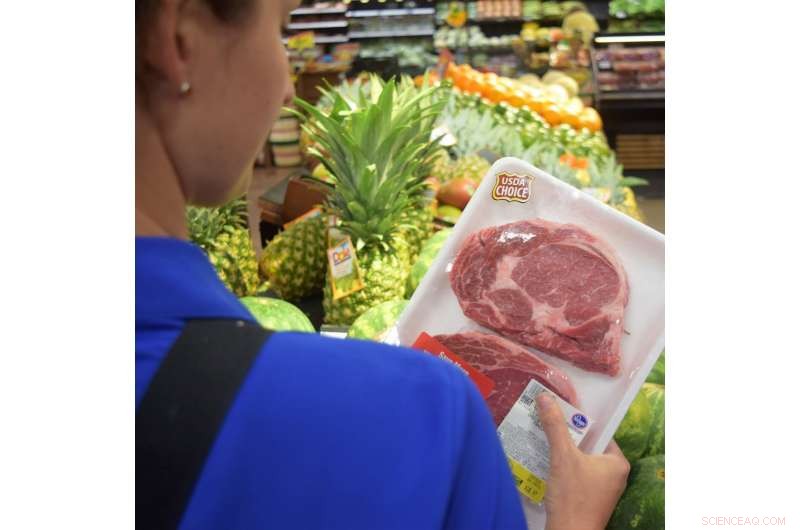
Consumers have the choice of eating animal- or plant-based food products. Credit: PNAS
(Phys.org)—A pair of researchers affiliated with both Virginia Polytechnic Institute and the U.S. Department of Agriculture has conducted an intriguing exercise—simulating the impact on the American diet and changes in greenhouse gas emissions if animal food products were completely eliminated from production, consumption and sale in the US. In their paper published in Proceedings of the National Academy of Sciences, Robin White and Mary Beth Hall describe how they built their simulation and what was revealed by running it.
Over the past couple of decades, many inside and out of the science community have suggested that the United States and other countries would be better off if we all stopped eating animal products, e.g. meat, dairy, poultry, etc. Water and land used to grow animal feed, for example, could instead be used to grow human crop foods. Also, getting rid of all those animals would surely reduce the amount of greenhouse gases emitted, both from methane emitted directly from the animals and from exhaust emitted by tractors growing plants to feed the animals. But until now, no one has put this theory to the test. In this new effort, the researchers created their simulation by envisioning the U.S. as it is now, but without any animals grown to produce food products and no animal food products being imported into the country.
After entering statistics related to crops grown for feed, water used grow it, estimates of methane emitted and multiple other factors, the researchers ran the simulation and analyzed resulting data. Removing animals from the food business, they report, resulted in 23 percent more food grown for human consumption due to conversion of land currently used for feed production to crops for human consumption. But still, even with all that new food, the researchers also found that if all Americans switched to a vegan diet, there would be mass deficiencies in minerals, vitamins and fatty acids among the populace.
They also note that approximately 16 million people are employed in the animal food business, which they did not add to their simulation, but which would have to be accounted for in real-world estimations. They also found that there would be a reduction in greenhouse gas emissions (approximately 28 percent), but not as much as expected due to the need to synthesize fertilizers to replace those created by farm animals. They suggest their simulation shows that adopting a strategy to benefit society, even one that seems simple at the outset, may not be as clear-cut as it might seem.
© 2017 Phys.org