Credit: University of Western Sydney
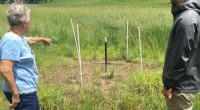
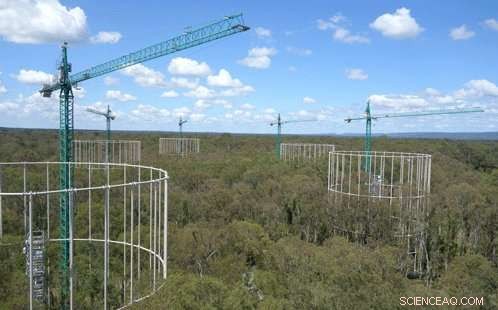
Since its launch in 2012, the EucFACE experiment, based at WSU's Hawkesbury campus, has exposed a patch of native forest in north-west Sydney to high levels of carbon-dioxide—replicating our predicted future atmosphere.
Levels of carbon dioxide in our air are increasing steadily every year and are now over 400 parts per million, the highest recorded levels in hundreds of thousands of years.
The experiment is designed to give scientists a window into the future responses of our native Eucalyptus-based forests and determine how they will respond to a whole new level of CO2.
By exposing selected patches of forest to carbon dioxide-enriched air, scientists can compare those treated patches with equivalent untreated sections to see what specific differences are caused by the extra CO2 in the air.
Importantly, there are some revealing results that answer some of the questions scientists have been asking as well as opening up new questions about what these findings indicate for forestry, agriculture and plantation timber production across our landscape.
Key highlights emerging from the research indicate that:
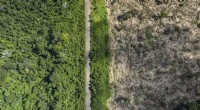
These findings are the first available insights into the changes that rising CO2 will bring to the 160 million hectares of native forest in Australia, influencing the decisions being made about how effectively our land and its vegetation can act as a source for growing carbon emissions.
"Without EucFACE, prediction models would rely on data gathered from experiments run in the northern hemisphere, which were based on richer soils where nitrogen was usually the limiting factor and the trees were young and vigorous pines", explains Professor David Ellsworth, Lead Scientist on the EucFACE project.
"Results from EucFACE are already demonstrating that there is quite a limit on the ability of Australian forests to take up more atmospheric carbon, and in fact there are many subtropical and tropical forest regions that also lack the nutrients needed to put on more growth over the long term."
"The predictive models we use to forecast future scenarios may need to be modified to take this new research into account so that the decisions being made are current accurate."