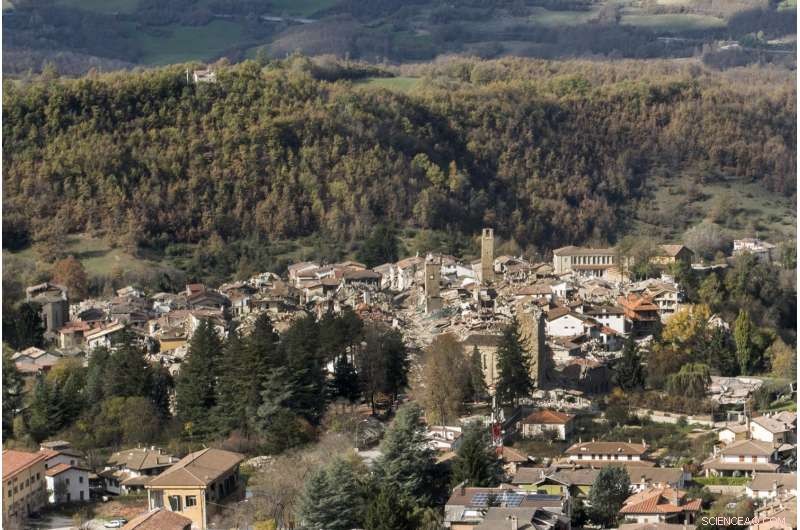
The village of Amatrice, completely destroyed by the central Italy seismic sequence of August-October 2016. Credit: Marco Anzidei
(Phys.org)—A trio of researchers with Istituto Nazionale di Geofisica e Vulcanologia in Italy has created an earthquake warning system that reliably predicted a series of aftershocks after a major quake in Italy. In their paper published on the open-access site Science Advances, the team describes the system and its accuracy in predicting the series of aftershocks that occurred during 2016 to 2017.
Scientists have long sought forecasting methods for earthquakes, for obvious reasons—unfortunately, to date, little progress has been made despite hundreds of years of effort. Science has advanced one area of forecasting, however: aftershocks that occur after a major quake.
It has been noted that aftershocks can occur in sequences that frequently follow a power series. Because of that, seismologists could make predictions of aftershocks based on the degree of severity of the preceding major quake. But, as the researchers note, there are exceptions—sometimes, aftershocks seemingly occur randomly. Occasionally, they even precede a large quake. It was these exceptions that the researcher sought to address with a new and improved earthquake prediction system.
The system built by the team is called an Operational Earthquake Forecasting (OEF) system, and is based on three predictive models. The first two are models known as epidemic-type aftershock sequences (ETAS), which use clustering information to make predictions. The third was based on the short-term earthquake probability model (STEP), which, as its name implies, is math based.
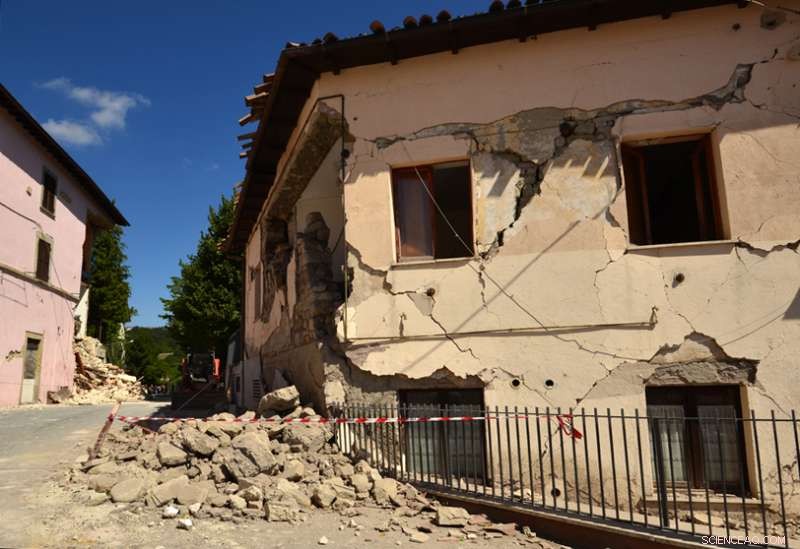
A damaged building at Accumuli by the Amatrice earthquake (August 24, 2016). Credit: Marco Anzidei
After refining their system, the researchers entered real-world data from a major earthquake that occurred in Amatrice Italy in 2016 and from the series of aftershocks that followed. The aftershocks were so unusual that earthquake experts gave them their own name: the Amatrice-Norcia seismic sequence. After running the system, the researchers found that it "issued statistically reliable and skillful space-time-magnitude forecasts" for the event.
While the results are promising, the researchers are quick to point out that their system is still in the pilot stage, and thus, it is still unclear how well it might perform when used to predict aftershock patterns that occur after future earthquakes.
© 2017 Phys.org