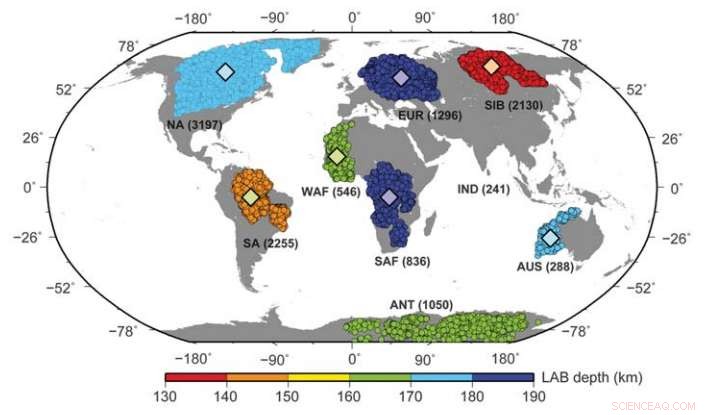
Continental SS bounce point map. Credit: (c) Science (2017). doi: 10.1126/science.aan0741
(Phys.org)—A trio of researchers with the University of Southampton in the U.K. has used a new technique to gain a better perspective on the thickness of the Earth's continents. In their paper published in the journal Science, Saikiran Tharimena, Catherine Rychert and Nicholas Harmon describe using seismic reflections associated with surface bounces to gain a better understanding of craton boundaries. Brian Savage with the University of Rhode Island offers a short history of research into the boundaries of the continents in a Perspective piece in the same journal issue, outlines the new effort, and explains how the results fit in with other theories.
The Earth's lithosphere includes the oceans, crust and portions below, which sit above the mantle. The lithosphere also includes the continents. Although much is known about the continents, one major mystery remains—just how thick are they? Several theories have been developed with estimates ranging from 135 to 400 kilometers, but no one has come up with a consensus method to test the thickness. In this new effort, the researchers report a new possibility.
To learn more about the inner workings of the planet, scientists rely mostly on monitoring seismic waves generated naturally during earthquakes. Such waves are categorized into different types and move through parts of the planet in different ways. By noting changes in the speed of such waves, researchers are able to learn more about the materials they encounter. To learn more about continental depth, the researchers gathered seismic data from hundreds of earthquakes that have occurred in multiple regions, noting where they changed speed relative to cratons, which are believed to be the oldest parts of the continents—they sit at or near the boundary between the lithosphere and the mantle.
The researchers report that they found speed changes at depths of 130 to 190 kilometers, which just so happens to be the same depth range as diamonds found in xenoliths (rocks pushed to the surface by volcanoes) that have stabilized. It is also in the same range as melt deposits found by other researchers. Collectively, the work suggests that the thickness of the continents is the thickness of the crust plus 130 to 190 kilometers.
© 2017 Phys.org