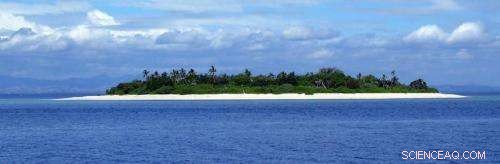
A small Fijian island. Credit: Remember/Wikipedia
(Phys.org)—A team of researchers from Japan, the Philippines and Vietnam has found real-world evidence of people refusing to leave their island homes even after an earthquake has caused severe flooding to occur every high tide. In their paper published in the journal Nature Climate Change, the group describes their study of the people on the islands of Tubigon, Bohol, Philippines, and what their findings suggest about other island people responding to rising ocean levels due to global warming. Dominic Kniveton with the University of Sussex offers a News & Views piece on the work done by the team in the same journal issue.
Many scientists around the world have been warning of the expected dire consequences of rising ocean levels due to global warming. Millions of people, they say, will have to migrate when their island homes become submerged. This mass migration, they note, will likely cause enormous problems unless governments plan ahead. But some of those estimates might be premature, the researchers conclude. Many islanders may instead opt to stay, choosing to adapt rather than move from their homes.
To learn more about possible migration caused by rising ocean levels, the researchers ventured to the islands of Tubigon, Bohol, in the Philippines. An earthquake back in 2013 caused four of the islands in the community to sink to the point that they are now very nearly covered with water every high tide. The Philippine government offered the islanders housing on the mainland, but many chose to stay regardless of the hardship. To find out how and why this was possible, the researchers conducted door-to-door surveys, led focus groups and interviewed community leaders. They report that the main reasons the islanders gave for choosing to stay was fear of losing their livelihood and questions about safety in a new place. Many of those who chose to stay built up their homes using coral, or resorted to congregating in safe areas during high tides. Also, groups organized rainwater harvesting events to preserve potable water.
The attitudes and actions of the island people in the Philippines suggests, the researchers claim, that many of those considered future refugees due to climate change may not be after all.
© 2017 Phys.org