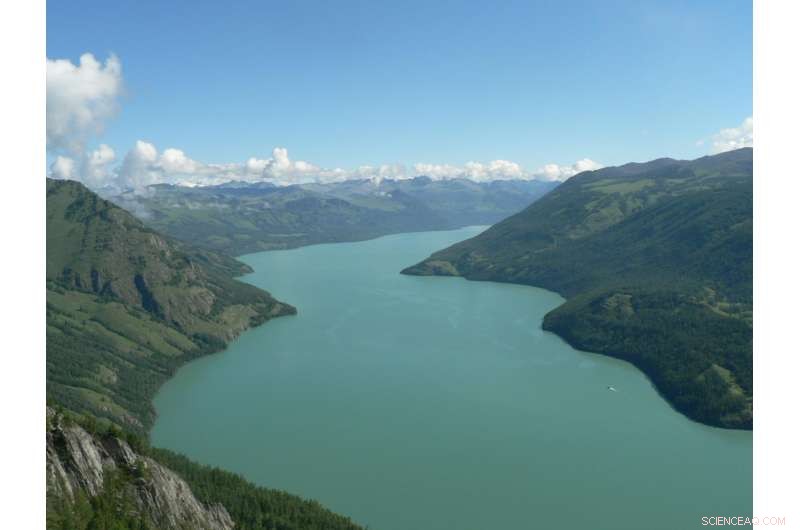
Lake Kanas. Credit: Wikipedia/CC BY-SA 3.0
(Phys.org)—An international team of researchers has found that levels of phosphorous found in Chinese lakes have fallen on average over the past nine years. In their paper published in the journal Nature Geoscience, the group describes how they examined data from government sources and what they found by doing so. Jessica Corman with the University of Wisconsin offers a News & Views article covering work done by the group in the same issue giving some opinions regarding what she believes still needs to be done.
Phosphorous can cause increases in algae blooms in lakes, which in turn can cause reductions in oxygen levels, making it difficult for fish and plants to survive. The whole process is known as eutrophication. As phosphorous levels rise, the problem becomes worse. Officials in China recognized the problem in lakes throughout the country, and several years ago, adopted measures to reduce levels by improving sanitation efforts. In practice, this meant building waste treatment plants that cleaned water before pumping it into lakes or streams. This effort, the researchers report, has led to a reduction in the average amount of phosphorous in China's lakes.
After studying 850 datasets collected over the years 2006 to 2014 the researchers found a decline in phosphorous levels in approximately 60 percent of those listed—median concentrations declined from 80 μg l–1 to 51 μg l–1. The researchers noted that the highest level they found was 200 μg l–1. They also noted that the biggest declines occurred in the lakes with the highest concentrations during the early years of the cleanup effort. The declines in many of the lakes studied were enough to stop eutrophication from occurring.
But, as Corman notes, the problem of phosphorous buildup in Chinese lakes is not solved. There are still other sources that need to be reduced, most notably runoff from agriculture. The researchers also found that phosphorous levels were actually higher in some sparsely populated areas, which they suggest could be due to increased rainfall and erosion of soil due to global warming.
© 2017 Phys.org