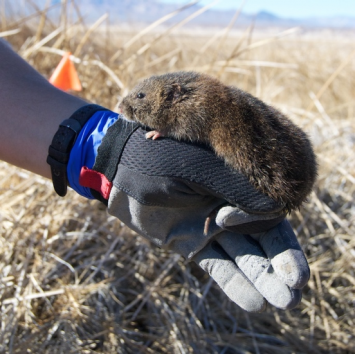
Austin Roy of the California Department of Fish and Wildlife offers a helping hand to an endangered Amargosa vole. Credit: Andrew DiSalvo/California Department of Fish and Wildlife photo
Despite the welcome rains in California this year, the fate of endangered Amargosa voles that depend on rare marshes in the Mojave Desert remains dire, with only about 500 animals remaining in the wild and most of their habitat degraded or dying.
Comprehensive planning to mitigate human-caused climate change, secure water, restore and enhance marshes, and manage vole genetic and disease stressors are urgently needed to reduce the species' high extinction risk. That is according to a report detailing a wide-range assessment commissioned by the California Department of Fish and Wildlife and implemented jointly by biologists with the department, UC Davis and the U.S. Geological Survey.
Over the past five years, the team has conducted intensive research and initiated last-ditch intervention attempts to save the species—including a captive breeding program at the UC Davis School of Veterinary Medicine. But these efforts may not be enough.
Increased risk of extinction
The researchers found that as of 2016, water to support this highly specialized rodent is becoming increasingly variable. As a result, risk of extinction for this species—entirely dependent on marshes near Tecopa Hot Springs, Inyo County—has increased over the last decade.
"Retrospective satellite data provide pictures of vegetation over time, giving us the best proof to date of the effect of climate change over several decades," said project lead Janet Foley, a professor of medicine and epidemiology at the School of Veterinary Medicine. "Even occasional rainy seasons won't combat the water insecurity we are witnessing in this driest part of the Mojave Desert."
Key findings from the report
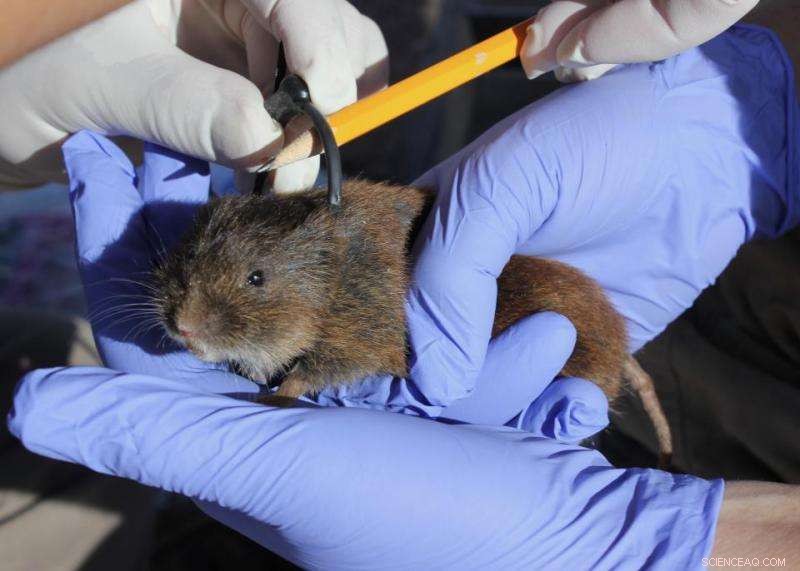
In the field: Radio collar is attached to an endangered Amargosa vole. Credit: Risa Pesapane/UC Davis photo
"This conservation effort to save the vole and its fragile ecosystem represents the tireless work of a diverse group of dedicated professionals and community members," said project co-lead Deana Clifford, senior wildlife veterinarian with the state Department of Fish and Wildlife. "Only by continuing to work together will we find proactive climate and water solutions that can support the marshes and voles, as well as the desert communities of the Amargosa."