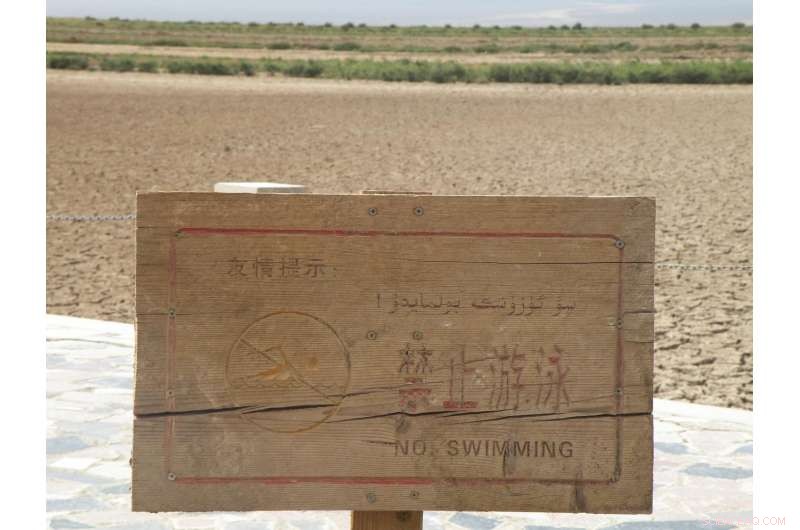
“No swimming” says the sign. This should not be a problem given that this lake in the Turfan Basin of far western China has dried up completely within the past decade as the planet has warmed and precipitation has shifted away from this region. Credit: Aaron E. Putnam.
(Phys.org)—A pair of researchers with the University of Maine and Columbia University has conducted a study of the past to make predictions about rainfall patterns in coming years. In their paper published in the journal Science Advances, Aaron Putnam and Wallace Broecker outline their study and offer three ways they believe planetary warming might influence the global distribution of rainfall.
As the planet heats up due to greenhouse gas emissions, it is logical to assume that there will be more rainfall—warmer air holds more moisture. But where will that moisture fall, and will some areas actually see less? That is what planetary scientists are trying to figure out. In this new effort, the research pair studied a period during which the planet was warming after a cool spell to learn more about future rainfall distribution.
One of the big factors impacting rainfall distribution, the pair note, is the fact that the Northern Hemisphere has a lot more land mass than the Southern Hemisphere—more land mass means more heat, which means the Northern Hemisphere will almost certainly see more of rainfall than the Southern Hemisphere. To learn more about how it may all play out, the researchers looked at paleoclimate data from various parts of the planet, such as closed lake basins, stalagmites and ice core samples. They also looked at materials that have been carbon dated to assemble a picture of how and where rainfall patterns changed during a time of similar warming approximately 14,600 years ago. That led them to conclude that three scenarios are likely.
The first is that tropical rainfall will increase while subtropical areas will get less rain. The second is that it is likely that the planet's rain belts and dry zones will shift north. The third is that it is possible that the first two scenarios will occur at the same time. This all means that tropical areas will get more rain, while the fringes and middle latitudes will likely see less rain. That might mean stronger summer monsoons, they note, and dry places like the western United States and Mongolia getting even drier.
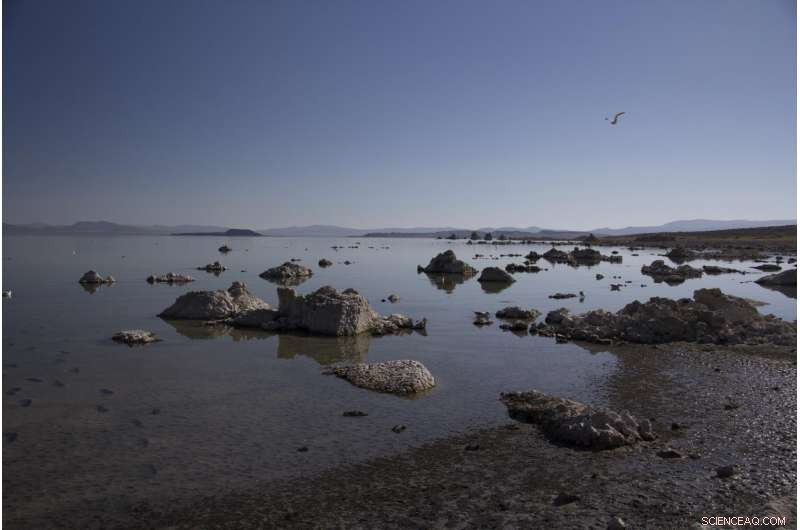
Shoreline of Mono Lake, California in 2013. Ancient shorelines etched into the eastern flank of the Sierra Nevada indicate that this lake stood at a much higher level at times when the climate was cooler. Climate-driven reorganizations of the world’s water system during ancient periods of warming starved this lake of moisture, causing the shoreline to drop. Now we are witnessing a similar phenomenon. Today, as the increase in fossil CO2 warms the Northern Hemisphere faster than the Southern Hemisphere, the moisture that normally feeds the Sierra Nevada is being routed farther to the north. As a consequence, the level of Mono Lake has dropped. Credit: Aaron E. Putnam.
© 2017 Phys.org