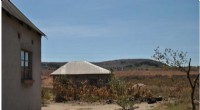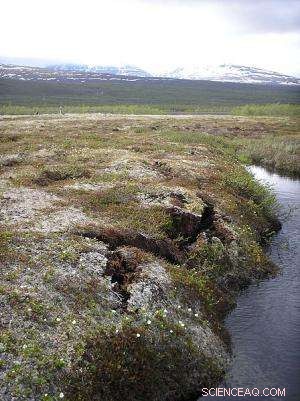
Permafrost peatbog border. Storflaket, Abisko, Sweden. Credit: Dentren/Wikipedia
(Phys.org)—A team of researchers from Sweden, Denmark and Finland has conducted field experiments that offering evidence that suggests permafrost melting in the Arctic could release major amounts of nitrous oxide into the atmosphere. In their paper published in Proceedings of the National Academy of Sciences, the group describes their experiments and explain why they believe nitrous oxide emissions could have a bigger than thought impact on the speed at which the planet is heating up.
Scientists know that nitrous oxide is also a greenhouse gas, but because far less of it is emitted into the atmosphere, it has not generated the same degree of interest as carbon dioxide. But that might have to change, as the researchers suggest that the impact of melting permafrost might lead to the release of massive amounts of the gas. This could be a problem because nitrous oxide causes more blanketing in the atmosphere than carbon dioxide—prior research has shown it to be 300 times as heat retaining. It also has an atmospheric lifetime of 110 years and when it does finally break down it takes some atmospheric ozone with it. Currently, the largest natural source of nitrous oxide are rainforests, the researchers note, but that could change, they contend, as global warming causes permafrost to melt.
The researchers came to this conclusion by conducting tests on 16 peatland "mecocosms" in Finnish Lapland they designated. Each was a plot of land over permafrost, approximately 80 by 10 centimeters. Some were covered in plants, others lichen, while others were bare. Each plot was subjected to different conditions that caused the permafrost to melt over the course of 33 weeks while the researchers took core samples and used sensors to measure the amount of nitrous oxide released.
The group reports that the plots covered in plants or water did not release much of the gas, but the bare plots released as much of the gas as a similar plot in the rainforest, which was five times as much as normal. This, they contend, becomes more important in light of prior research finding that approximately one-fourth of the Arctic landmass area is bare peat and that warming in the area is expected to cause relatively dry melting.
© 2017 Phys.org