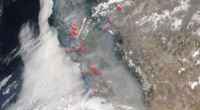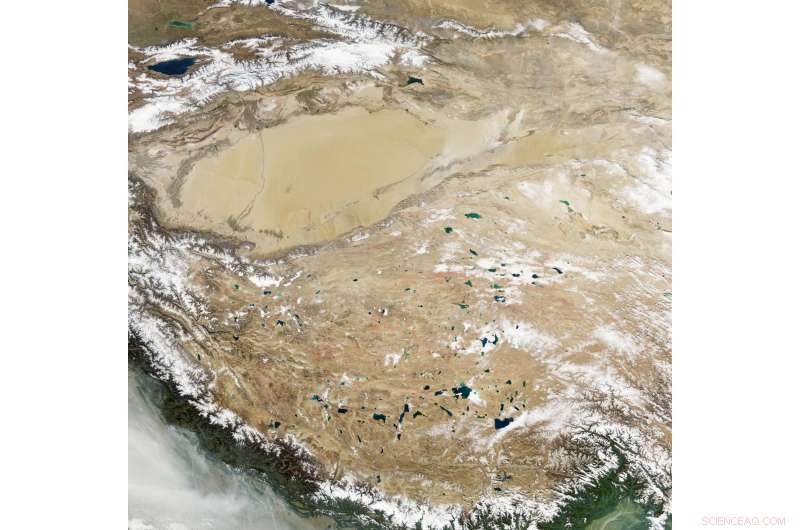
Natural-colour satellite image of the Tibetan Plateau. Credit: NASA
(Phys.org)—An international team of researchers has found that carbon uptake in the Tibetan Plateau may actually offset the carbon that is released as permafrost melts. In their paper published in the journal Nature Geoscience, the team describes soil readings they analyzed from the region and what their findings suggest about carbon release in cold parts of the world.
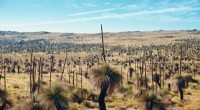
Anyone paying attention to the science surrounding global warming has heard about the problem of carbon released into the atmosphere due to permafrost melting in colder parts of the planet. Less well known or understood is what happens to the soil above the permafrost. As temperatures rise, soil above the permafrost becomes warmer, offering a haven for new plant growth—such plants have been found to sequester carbon from the air back into the soil. Thus, as more carbon is released from below, more is sequestered from above, but is it possible that new sequestering offsets old release? That is what the researchers with this new effort want to know. To learn more, they studied soil samples taken from multiple sites in the Tibetan Plateau (a large elevated plateau north of the Himalayas) in the early 2000s and compared them with similar samples taken a decade later.
The researchers report that the soil samples were taken from depths up to 30 cm (which is above the permafrost line) and found an average accumulation of carbon in the soil to have occurred at a mean rate of 28.0 g cm−2 yr−1, which they concluded was due to accumulation of organic carbon concentrations (material left when plants died). They describe the increase as substantial, and possibly enough to offset carbon released due to permafrost melting. More tests will have to be conducted to determine if there is a true offset, but the study results suggest that climate change models might have to be adjusted if offsetting occurs in regions much farther north. If carbon released by melting permafrost in Russia, Canada and other parts of the world is offset by new plant growth, it is possible that much less carbon will make its way into the atmosphere than has been predicted, resulting in slower than predicted global warming.
© 2017 Phys.org