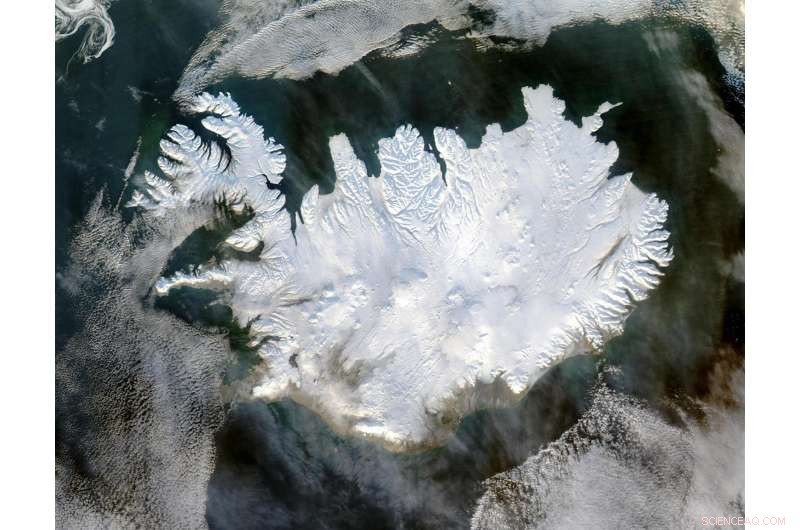
Iceland. Credit: Jeff Schmaltz, MODIS Rapid Response Team, NASA/GSFC
(Phys.org)—A trio of researchers with the University of Cambridge and the University of Strathclyde has found evidence of a giant, five-fingered Icelandic mantel plume. In their paper published in the journal Earth and Planetary Science Letters, Charlotte Schoonman, Nicky White and David Pritchard describe how they carried out tomographic imaging of the area and developed a theory regarding why the plume has fingers.
Prior research has shown that Iceland and a large part of the area around it was very strongly impacted by a mantle plume beneath the area. Mantle plumes are chimney-like structures that move hot rock from deep within the planet to the surface. The one in that part of the world was responsible for the creation of the volcanoes that led to the formation of Iceland. Using tomographic imaging, the researchers found that the plume was semi-star shaped with five tendrils. Intrigued, they began searching for an explanation.
They noted earlier studies demonstrating how star-like structures form when fluids with different viscosities are mixed in a confined space, such as in a glass container. They further noted that at approximately 100 kilometers below the surface of the earth, there is a layer called the asthenosphere. It is a layer of soft rock that flows horizontally between two other layers of non-moving hard rock. The researchers suggest that the semi-star-shaped Icelandic plume got its shape the same way the stars did in the lab. Hot, runny rock was pulled up from below, and it then spread horizontally as it met the asthenosphere—at least on one side. On the other side of the plume, moving west, the crust beneath Greenland was so hard and thick that it created a barrier. Thus, the plumes only moved north and south and especially east—as far as Scotland and Norway.
The researchers suggest the fingers from the plume may even explain why coastal Norway and northern Scotland manage to stay above the water line despite both existing over unusually thin parts of the crust. The plume material is buoyant, they note, which suggests parts of Norway and Scotland are actually floating.
© 2017 Phys.org