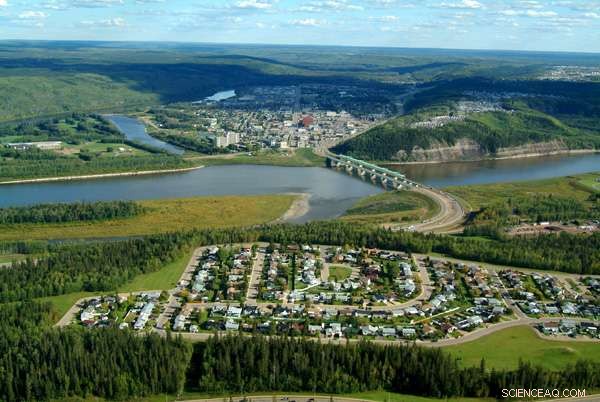
Aerial view of Fort McMurray. Credit: Regional Municipality of Wood Buffalo/ Wikipedia
(Phys.org)—A team of researchers affiliated with several institutions in Canada has found that using an airplane to carry emissions reading hardware over mining facilities offers a better way to measure volatile organic compounds (VOCs) being pumped into the atmosphere than methods currently in use. In their paper published in Proceedings of the National Academy of Sciences, the team describes what they found when they used their flying emissions reading lab over a real oil sands surface mining facility and why they believe similar approaches should be used for other facilities around the world.
As difficult as it may be to believe, governmental agencies in the U.S. and Canada both rely on self-reporting by oil companies to determine if such companies are complying with federal regulations when making policy regarding reversing the impact of global warming. As the researchers note, such data is typically obtained by installing monitoring devices on smokestacks or other obvious sources of emissions—but they do not measure emissions from leaks and other operational areas—instead they use math, extrapolating data from other substance emissions to make estimates of VOC emissions. But as the researchers also note, to date, the means by which oil companies come up with their data has not been tested. In this new effort, the research team sought to do just that by installing air monitoring equipment on an airplane and then flying over a mining facility and taking air samples, testing them, and then comparing what they found with statistics given by the oil company.
To get good readings, the researchers flew in a 275-square kilometer box pattern at different altitudes over a surface mining facility collecting samples every hour for several hours. The samples were then returned to their lab for analysis. The team reports that their readings were from two to 4.5 times higher than the readings given by the oil company, suggesting that the company was vastly underreporting the amount of VOCs it emits.
The researchers note that their technique could be used on a wide variety of mining operations, including hydraulic fracturing and oilsands projects. It could also be modified to test for more than just VOCs to get a better picture of all the pollutant types emitted at a given site.
© 2017 Phys.org