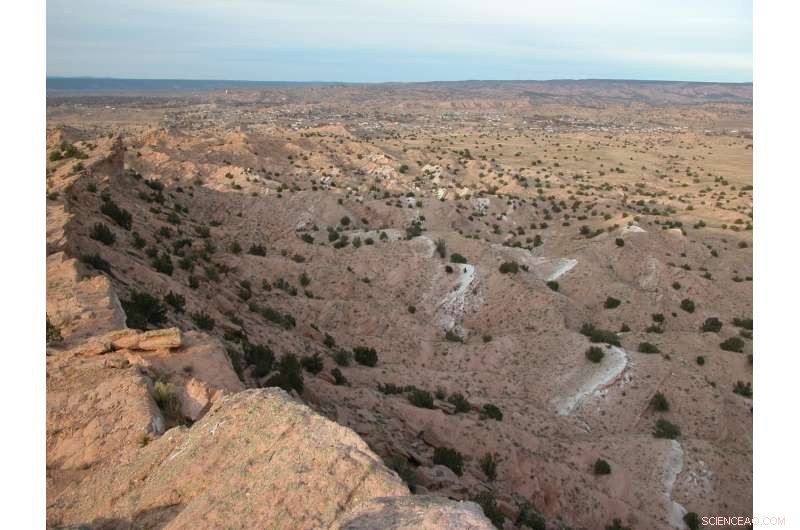
Overview of faulted intrabasin rift sediments in the Española Basin, NM . Credit: USGS
(Phys.org)—A team of researchers with the University of Wisconsin, Berkeley and the New Mexico Institute of Mining and Technology has used U-Th testing of coseismic calcite veins at the Loma Blanc fault in New Mexico to learn the earthquake history of the fault going back almost a half-million years. In their paper published in Proceedings of the National Academy of Sciences, the group describes their study and their assembly of the longest seismic record ever made of any fault in the world.
In most cases, it is difficult if not impossible to obtain an earthquake history for long periods of time for most fault lines, but the Loma Blanc fault is different—earthquakes there have left co-seismic calcite veins that offer a means for documenting earthquakes going back approximately 550,000 years. All that was needed was to date the material in the veins (using radioactive isotopes of uranium and thorium) and then to measure the distance between them. After doing so, the researchers report that earthquakes occurred at fairly regular intervals for most of the timeline they built, as was expected, but they also found that for one short period of time approximately 430,000 years ago, there was a cluster of larger-than-normal earthquakes.
After more digging, the researchers found that the cause of the earthquake cluster was sand being forced upward through the rocks below them, which the researchers believe was due to overabundant water in the ground—too much water created extra pressure, which ultimately resulted in a rash of earthquakes. Why there was a period of too much water or flooding in the area is not known, but there was also a larger than normal release of carbon dioxide into the atmosphere. The team notes that the find is the first of its kind discovered to have occurred naturally.
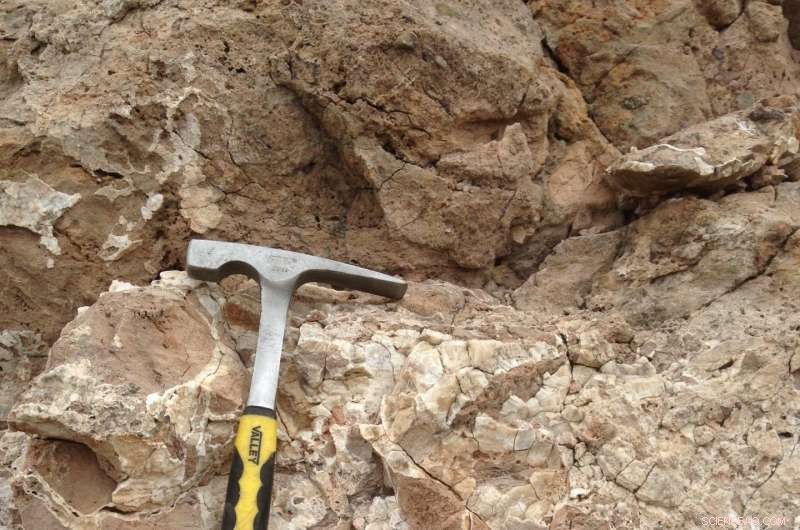
The white calcite 'veins' of the Loma Blanca fault are evident in this slab of rock on the fault. These veins of calcite reveal a record of fluid-driven earthquakes clustered together on a fault typically characterized by less frequent, periodic earthquakes caused by mechanical stress. They helped UW-Madison researchers trace the oldest and longest earthquake record ever documented. Credit: Laurel Goodwin and Randy Williams, UW-Madison
The researchers note that their findings are similar to events happening in modern times due to human activities, such as fracking and other operations that involve forcing water underground—the end result is unnatural earthquakes occurring out of sync with a fault's natural cycle.
© 2017 Phys.org