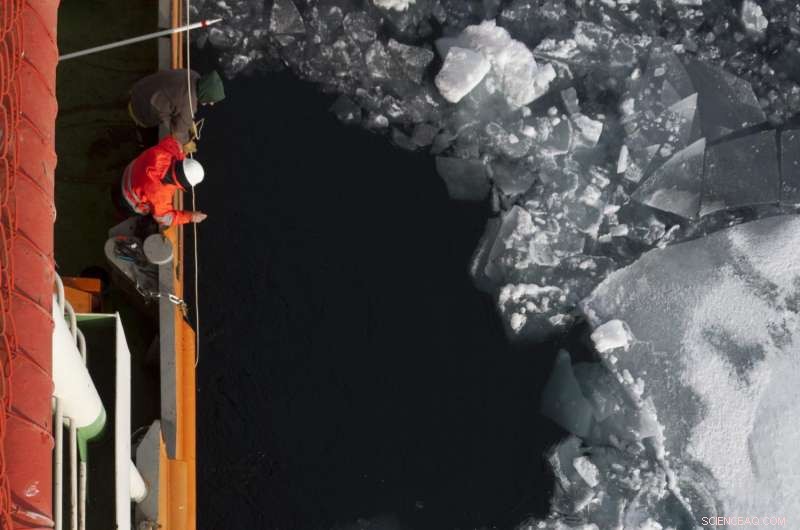
Recovery of mooring M6b north of Severnaya Zemlya on 30 August during NABOS 2015 cruise. Credit: © Ilona Goszczko
(Phys.org)—An international team of researchers has found that the eastern part of the Arctic Ocean is undergoing what they describe as "Atlantification"—in which the ocean is becoming more like the Atlantic Ocean. In their paper published in the journal Science, the group describes how they tracked ocean temperatures over a 15-year period and the changes they found.
The Arctic Ocean has traditionally been different from the Atlantic or Pacific in a fundamental way—the water gets warmer as you go deeper (due to inflows from the Atlantic) rather than the other way around, as happens with the other two. But now, the researchers with this new effort have found that may be changing. They have been using tethered moorings to record ocean temperatures at different depths for approximately 15 years and have found that changes have taken place—sea ice is melting from below, not just from above due to warmer air temperatures.
In studying the data from the moorings, the researchers found that warm water from the Atlantic, which has traditionally been separated from melting ice because of the halocline layer—a barrier that exists between deep salty water and fresher water closer to the surface—has been penetrating the barrier, allowing ice to melt from below. It has also led to the water becoming less stratified, like the Atlantic. They describe the changes as a "massive shift" in the ocean that has occurred over an extremely short time frame. These new findings may explain why the extent of ice coverage has been shrinking so dramatically—at a rate of 13 percent per decade.
The result, the researchers report, is a feedback loop—as more ice melts due to warmer air, more vertical mixing occurs, allowing warmer water to move upwards, which causes melting from below. They also acknowledge that it is not yet clear what impact the change might have, but suggest it is likely to be substantial—from the biogeochemical to geophysical levels, basic components of the ocean will likely be altered, causing changes such as phytoplankton blooms in places where they have never been seen before. They also note that there is another factor to consider—the massive amounts of fresh water pouring into the ocean from rivers in Siberia as permafrost thaws.
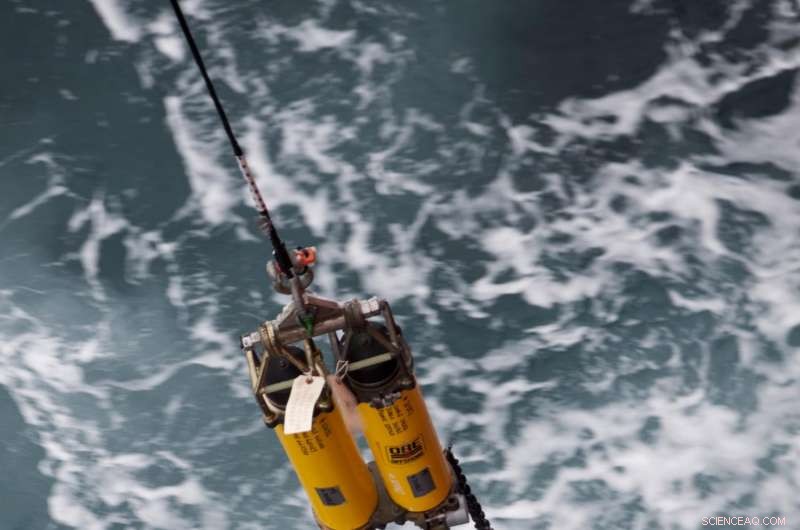
The mooring M5 anchor with the Bottom Pressure Recorder BPR before deployment on 17 September 2013 during NABOS 2013 cruise. Credit: © Ilona Goszczko
© 2017 Phys.org