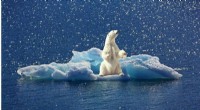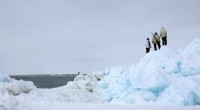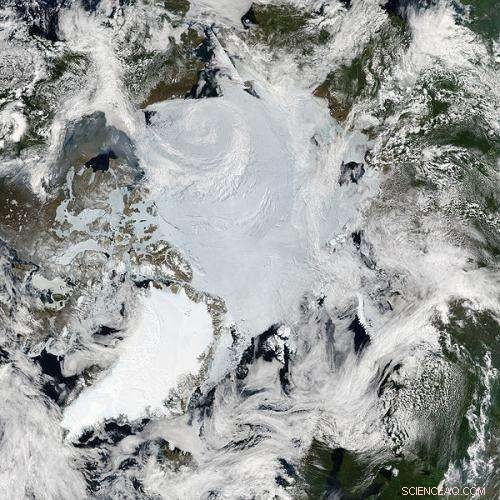
Mosaic of images of the Arctic by MODIS. Credit: NASA
(Phys.org)—A pair of researchers with the University of Groningen in the Netherlands has found via climate modeling that it appears likely that the Arctic is likely to see substantially more precipitation over the next century, much of it in the form of rain. In their paper published in the journal Nature Climate Change, Richard Bintanja and Olivier Andry describe their results when running 37 climate models programed to describe Arctic conditions over the years 2091 to 2100.
Over the past several years, climate scientists have been running various models in different ways trying to understand why Arctic sea ice continues to melt faster than models predict. In this new effort, the researchers took a closer look at the impact caused by changes in the amount of precipitation. They combined data from a variety of sources and used it to run 37 climate models, finding that the Arctic is likely to see an increase in precipitation by as much as 4 percent, which is double that for the rest of the planet.
They note that retreating ice leaves more open water, which leads to more evaporation and more snow and rainfall. The models suggested the rainy season in the Arctic will likely last longer in the future and reach farther north. They also theorize that sometime in the next century, it will be possible to navigate a ship to the North Pole because all of the sea ice will be gone.
In another study, an international team of researchers ran models of their own and concluded that almost half of the ice that has melted in the Arctic over the past century and a half may be attributed to natural changes such as variations in wind and water currents. They have also published their results in Nature Climate Change. They suggest that the reason so many climate models have failed to accurately predict how much ice would melt in the Arctic and when is because they fail to account for natural climate variations. They believe the Arctic is currently experiencing a natural warm spell, which, when combined with human-caused global warming, is causing ice to melt at very fast rate.
© 2017 Phys.org