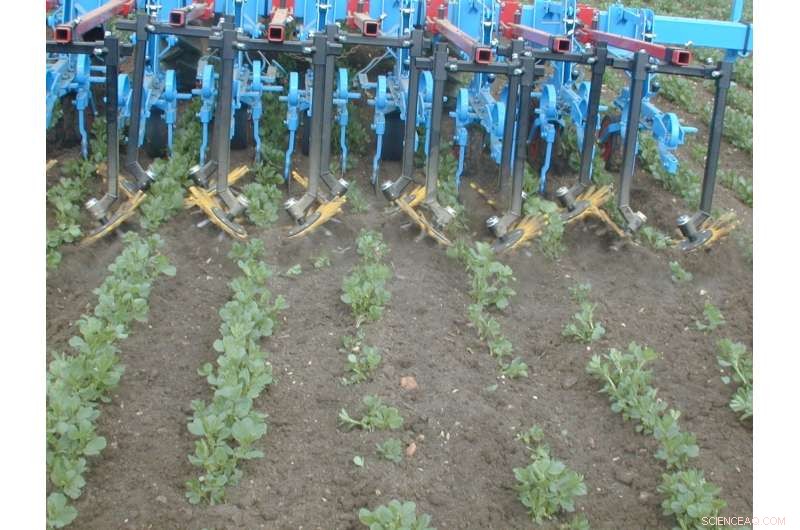
Mechanical weeding, an alternative curative strategy to control weeds. Credit: Pascal Farcy
(Phys.org)—A team of researchers with members affiliated with several institutions in France has found that lowering the amount of pesticides applied to crops does not have to mean lessening expected yields. In their paper published in the journal Nature Plants, the team describes their study of hundreds of French farms where pesticide use was varied to find out how much was actually needed. Vasileios Vasileiadis with Italy's Institute of Agro-Environmental and Forest Biology, National Research Council offers a News & Views piece on the work done by the team in the same journal issue.
There is no doubt that the use of pesticides to prevent insects from eating or otherwise destroying crop plants has led to huge yield gains in many places around the globe—but its heavy use has also caused negative side effects, such as runoff into the oceans causing dead spots. In this new effort, the researchers sought to learn whether the large amounts of pesticides used on farms are actually necessary to sustain yields. To find out, they accessed a database that held information on 946 non-organic arable commercial farms across France. The farms were part of the Dephy network, which was created as part of the government's Ecophyto initiative to reduce pesticide use—the farms represented a wide range of farming techniques, which included using nonstandard amounts of pesticides, herbicides and fungicides—each of the farms submitted reports to the database administrators detailing chemical use on their farms, crop yields and other details of their operations.
In studying reports generated by their analysis of the farms, the researchers found that 77 percent of the farms under study showed no conflict between using smaller amounts of pesticide and yield rates. They also found that the other 23 percent of the farms were generally associated with industrial farming, which is particularly dependent on high concentrations of pesticides to sustain yields. The researchers contend that their analysis also showed that approximately 59 percent of all farms in France could reduce their use of pesticides by approximately 42 percent without harming yields.
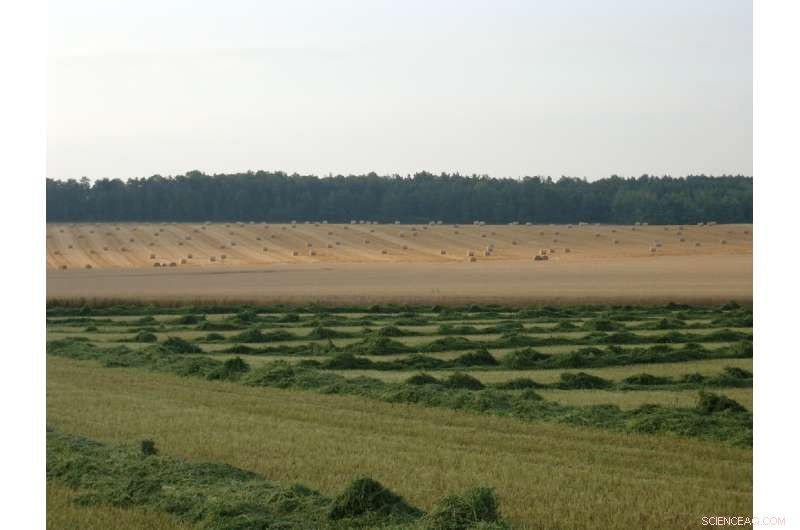
Crop diversity, a strong lever to reduce the reliance on pesticides. Credit: Gilles Louviot
Vasileiadis notes that the study results are important, because they show that it is possible for farmers to reduce their use of pesticides right now, without any real risk of financial loss.
© 2017 Phys.org