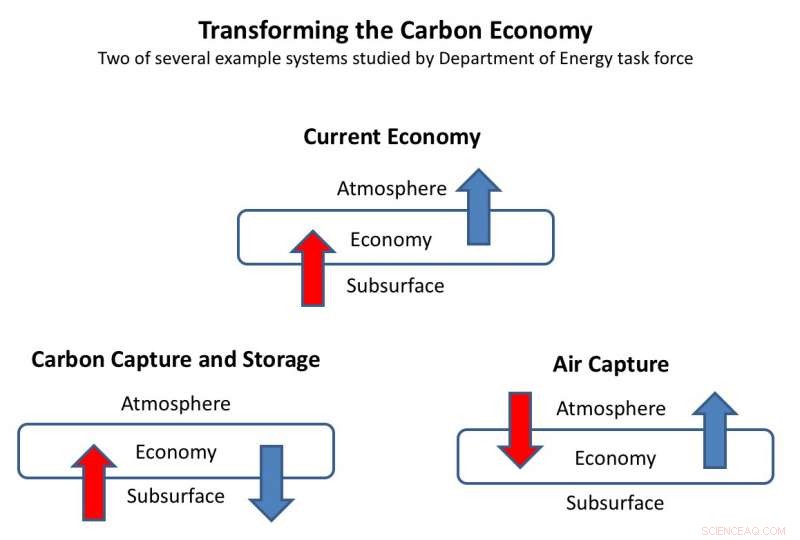
A task force commissioned by the US Department of Energy evaluated a suite of technologies potentially capable of dramatically changing the flow of carbon through the economy, while still using carbon-based fuels. In a simplification of the current economy (top), carbon flows from deep underground (red arrow) and is then burned, which releases carbon dioxide to the atmosphere (blue arrow). In one of the alternative scenarios considered by the task force (bottom left), the carbon dioxide is not allowed to escape to the atmosphere and instead is sent to secure storage below ground. In another scenario (bottom right), carbon dioxide is removed from the air, then transformed, with the aid of low-carbon energy sources such as wind or solar, into fuels, which are then burned and vented to the atmosphere. Credit: Princeton University
Most strategies to combat climate change concentrate on reducing greenhouse gas emissions by substituting non-carbon energy sources for fossil fuels, but a task force commissioned in June 2016 by former U.S. Secretary of Energy Ernest Moniz proposed a framework in December 2016 for evaluating research and development on two additional strategies: recycling carbon dioxide and removing large amounts of carbon dioxide from the atmosphere. These strategies were developed under a single framework with the goal to produce an overall emissions reduction for the Earth of at least one billion tons of carbon dioxide per year.
Task force members said that these approaches would complement carbon-free approaches based on electrification, including wind and solar energy, by fostering low-carbon strategies that retain liquid and gaseous fuels for distributive uses of energy in transport, buildings, and industry. These strategies could also enable overall net carbon removal from the atmosphere, if at some future time the world desires to reduce the global concentration of carbon dioxide. The task force considered only technologies that have the potential to achieve reductions on the scale of one billion metric tons of CO2 per year, which represents about 2.5 percent of annual global emissions (about 40 billion metric tons today).
Arun Majumdar, a Stanford University professor who chaired the Task Force of the Secretary of Energy Advisory Board, said that research avenues at such a large scale could potentially include utilizing agricultural crops to store more carbon in the soil, re-using carbon dioxide to form plastics and fuels, and storing carbon dioxide in massive underground reservoirs while producing some fuels.
"We are excited to have been able to provide the first steps toward a coherent strategy of research opportunities," Majumdar said. "The range of options that are ripe for research is truly impressive."
The task force, made up of participants from eight universities, focused on entire systems. In one example, plants are modified to increase their efficiency in capturing carbon dioxide from the atmosphere during photosynthesis and to develop deeper roots to store the carbon in the soil.
By the end of the process, the atmosphere has been scrubbed of the carbon dioxide, and carbon has been transferred from the atmosphere to the soil.
Sally Benson, a Stanford professor and a task force member, said a great deal of research is still needed on this process and others included in the report. "Each of the strategies we reviewed has its own research frontier," she said.
Because these strategies rely on industry-level solutions such as removing carbon dioxide at the smokestack or changing farming methods to retain carbon in the soil, they require development of new technology and new industrial processes.
"The need is urgent, and we must develop and use multiple strategies to combat climate change," said task force member Emily A. Carter, dean of the School of Engineering and Applied Science and founding director of the Andlinger Center for Energy and the Environment at Princeton University. "But pursuing these research avenues will benefit not just climate change. As we have seen for more than a century, investment in science and engineering research pays off in new technologies, new industries, jobs, and societal benefits far beyond the initial expense and in ways we cannot predict."
The task force recommendations were delivered in a report to Energy Secretary Ernest J. Moniz on Dec. 13, 2016. John Deutch, an emeritus professor and former provost at the Massachusetts Institute of Technology and the chair of the Secretary of Energy Advisory Board, said in a letter to Moniz that the report "has painted a scientifically interesting agenda for decarbonization that should be of interest to the scientific community writ large."
The task force - made up of experts from Duke, Harvard, Georgia Tech, MIT, Princeton, Stanford, University of Illinois and Washington University, as well as a former official from ExxonMobil - cautioned that the development of systems to reduce CO2 emissions at such a scale would be difficult and complex. The members also said some of the techniques could have unexpected outcomes and urged the government to invest in research to evaluate the impacts of the technologies, both intended and unintended, beyond their ability to reduce atmospheric CO2.
Taking steps to reduce atmospheric CO2 would require broad cooperation between academic researchers, government and policy leaders, and industry, the report concluded. An appendix to the report analyzes the flow of technology from labs to society and found all of these groups play a critical role in the development of new technology.
The task force made five recommendations about research and development:
"Our report should help people appreciate the immense effort that will be required to reconfigure our energy system to make it sustainable in the face of climate change, geopolitical stability, and responsible use of land," said Robert Socolow, a professor emeritus of mechanical and aerospace engineering and co-director of the Carbon Mitigation Initiative at the Princeton Environmental Institute. "Our report provides a useful structure for addressing the pluses and minuses of several less familiar approaches."