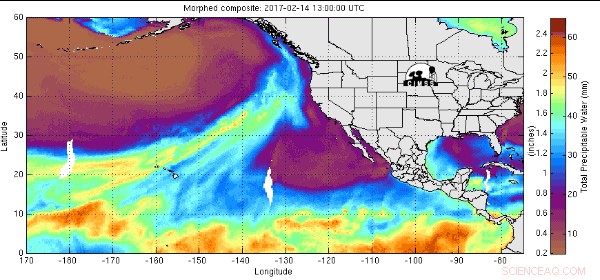
Credit: Nature Geoscience (2017). DOI: 10.1038/ngeo2894
(Phys.org)—A pair of researchers with the California Institute of Technology and the University of California has found evidence that suggests atmospheric rivers carry wind speeds higher than has been thought. In their paper published in the journal Nature Geoscience, Duane Waliser and Bin Guan describe their analyses of atmospheric river events that occurred over the years 1997 to 2014.
Atmospheric rivers are streams of air containing very large amounts of moisture—they typically move through storms releasing very large amounts of water (or snow) to the ground over short periods of time—generally in the mid-latitudes. Meteorologists have known about them for several years, but up until now, it was believed that their major impact was the huge amount of precipitation they deliver. In this new effort, the researchers have found that they occur more often than was known, and that they also carry higher winds.
In looking at the data, the researchers found that coastal areas are most likely to be hit by atmospheric rivers—approximately half of the top 2 percent of very strong coastal storms were found to be associated with atmospheric rivers. They also found that 40 to 70 percent of high wind and heavy precipitation events that occur along coastlines are at least partly linked to atmospheric rivers. Most surprising, they note, was the high winds that came with them—associated speeds were on average twice as fast as those with average storms. As an example, California has been hard hit this winter by multiple atmospheric river events—the huge amounts of rainfall have alleviated the drought that prevailed over the past few years, but there has also been a tremendous amount of flooding—and high winds have caused damage, perhaps most noticeably by the toppling of the iconic Tunnel Tree sequoia in Yosemite National Park.
The researchers note that atmospheric rivers can be extremely costly—over the time period studied, they determined that 14 of 19 storms that caused billions of dollars of damage in Europe were atmospheric river events. They also point out that global warming, by its nature, will mean more water in the atmosphere, which likely will mean bigger and stronger atmospheric river events.
© 2017 Phys.org