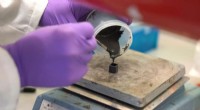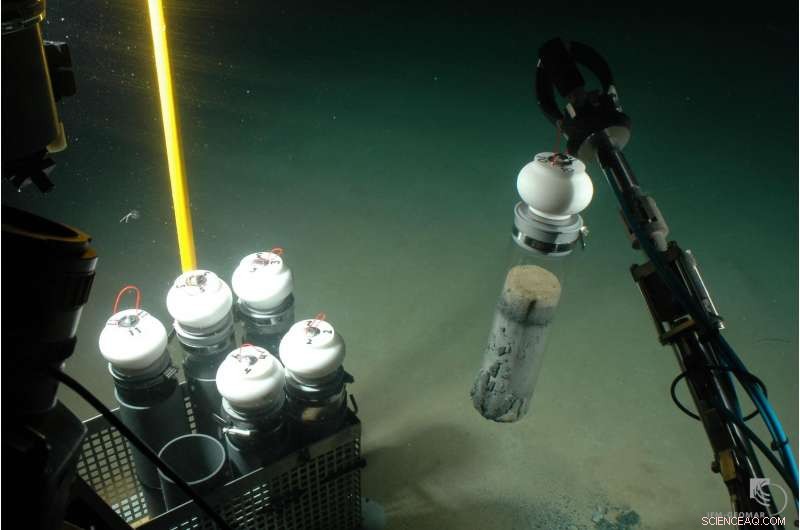
Retrieval of cores from the seafloor with the submersible JAGO. Below the black layer that is visible close to the sediment surface the sediment is free of oxygen. Credit: JAGO-Team, GEOMAR Kiel, Germany
(Phys.org)—An international team of researchers has found evidence in the Black Sea that suggests that even short periods of oxygen deprivation on the sea floor can cause animals and microbes that break up plant and animal matter to leave for very long periods of time. In their paper published in the journal Science Advances, the team describes their study of sea floor oxygen levels in the Black Sea and explain why their findings could have an impact on global warming.
When plants and animals that exist in the sea die, they are partially decomposed as their remains fall to the sea floor. Once there, bottom feeders and microorganisms continue the work of recycling such material back into the ecosystem. Sometimes, however, this process is interrupted by a loss of oxygen in a given undersea area, and some material on the bottom of sea the does not decompose—instead, it forms a sort of blanket of muck. There are natural processes that lead to oxygen-deprived zones in oceans and seas, but there are also human-made processes.
Fertilizers farmers use on crops, for example, make their way into rivers and streams and eventually into the sea—the Gulf of Mexico has a very large dead zone for this very reason, because algae that feed on the fertilizer suck up all the oxygen. Very little science has been conducted on accumulations of sea floor sediments due to oxygen deprivation, the researchers note, which is why they chose to set up sea-floor monitoring devices along a 40-kilometer stretch of the Black Sea—the largest oxygen-starved body of water in the world.
In studying data from their monitoring devices, the researchers found that 50 percent more organic matter was preserved in surface sediments exposed to hypoxia compared to oxygen-rich bottom waters. They also found that low oxygen events of just a few days could drive away animals and microorganisms for years or even decades. These findings, they note, have particular relevance as the planet warms—warmer water holds less oxygen and reduces recycling as warmer water tends to stay near the surface.
© 2017 Phys.org