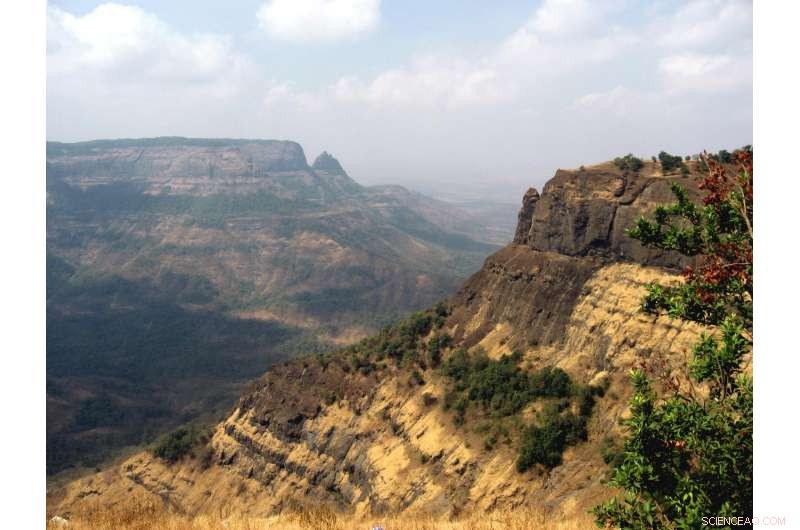
The Western Ghats hills at Matheran in Maharashtra, India. Credit: Nicholas/Wikipedia
(Phys.org)—A pair of researchers with the University of Florida has found evidence that suggests the formation of the Deccan Traps igneous province came about due to two eruptions from two distinct plumes. In their paper published in the journal Science, Petar Glišović and Alessandro Forte, describe how they created a computer simulation able to depict events that occurred in what is now India over 60 million years ago.
Deccan Traps is a very large igneous province located in west central India. Its existence has caused consternation among Earth scientists because of the huge amount of lava involved—too much, logic suggests, to be from a single eruption. Prior research has suggested it came about due to an eruption associated with a plume that now lies directly below Réunion Island in the Indian Ocean, approximately 66 million years ago. The eruption event that led to the creation of Deccan Traps also has historical significance—most Earth scientists believe it contributed to the decline of the dinosaurs by blocking sunlight and causing global temperatures to drop before an asteroid struck the planet, wiping them out altogether.
To gain a better perspective on what occurred during the creation of Deccan Traps, the research pair started by creating a 3-D tomography-based model that showed what the area looks like today—they then used that model to run iterations of change routines starting 2.5 million years ago that showed events that might have transpired to produce the physical geography that exists today. After selecting the best fit, the researchers ran the simulation to show what happened beginning 70 million years ago. They were surprised to discover their model showed two plumes feeding two eruptions simultaneously for approximately 10 million years—one under Réunion, as expected, and another called the Comoros plume.
The model also showed the peak occurred approximately 68 million years ago. The result was the melting and dispersal of approximately 60 million cubic kilometers of mantle. The model also suggested that the Comoros plume slowed dramatically approximately 40 million years ago, while the Réunion plume continued full force for another 20 million years. Both plumes still exist today, the researchers note, but both are extremely small compared to what they once were.
© 2017 Phys.org