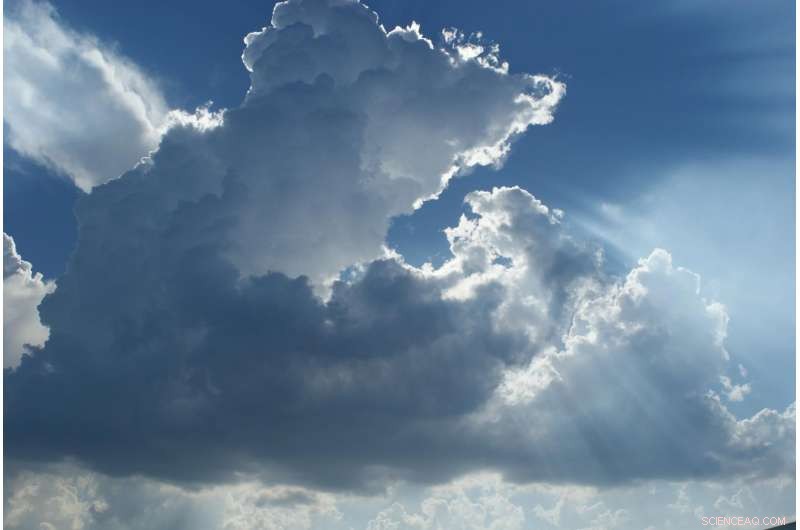
Credit: CC0 Public Domain
(Phys.org)—A large team of researchers with members from several institutions in the U.S., Korea, and the U.K. has found evidence of random radiation clouds in the Earth's atmosphere at elevations used by aircraft. In their paper published in the journal Space Weather, the team describes how they discovered the clouds and offers a theory for their existence.
For several years, NASA has been conducting a project called Automated Radiation Measurements for Aerospace Safety (ARMAS)—devices are placed aboard aircraft that measure radiation levels during flights; readings are recorded in a database for study. In this new effort, the researchers accessed the database and examined data from 265 flights during the period 2013 to 2017. In so doing, they found mostly what was expected—higher than ground levels of radiation. But they also found unusual readings—six instances of high altitude and high latitude flights during which radiation levels rose to twice the normal level for several minutes. The researchers described the events as flying through a radiation cloud.
Increased radiation exposure is, of course, the norm for people aboard an airplane due to their closer proximity to outer space. But the risk from such flights is considered small—equivalent to a chest X-ray for longer flights, or a dental X-ray for shorter flights. Such radiation comes from space courtesy of the solar wind or from other sources in outer space. Our atmosphere and magnetic poles filter enough of it to enable Earth. But we do experience geomagnetic storms sometimes, during which electrons escape from the Van Allen radiation belts (zones of charged particles surrounding the planet that have been captured by the Earth's magnetic field) and rain down to the surface. Data from the ARMAS devices indicated that the radiation clouds might be linked to such storms.
The discovery of such clouds suggests that frequent flying at high altitudes (above 55,000 feet) may be slightly more hazardous than has been thought. The researchers suggest that sensor networks could be used to create a grid for pinpointing such clouds to allow rerouting of airplanes around them.
© 2017 Phys.org