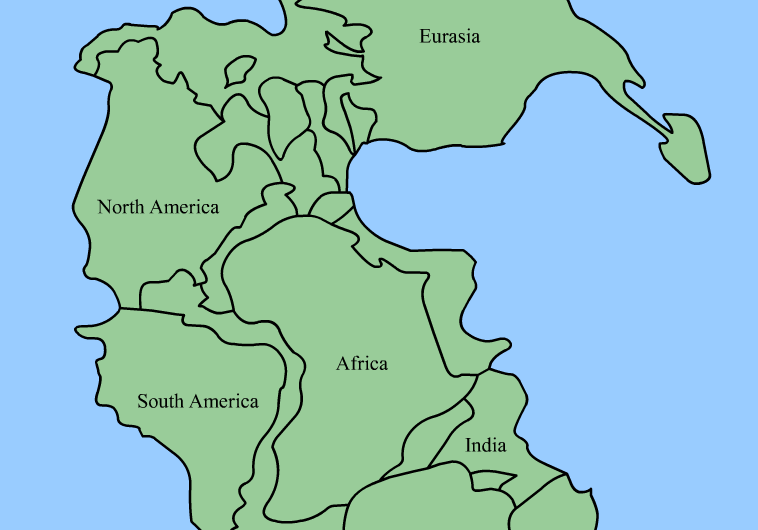
Map of Pangaea showing where today's continents were at the Permian–Triassic boundary. Credit: Wikipedia
(Phys.org)—A team of researchers with members from several institutions in China and the U.S. has found evidence of uncharacteristic shoaling before, during and after the great die-off 250 million years ago and suggest it could be the cause of so many species going extinct. In their paper published in Proceedings of the National Academy of Sciences, the team describes evidence they found in rocks in Canada and Japan that suggests at least part of the great die-off was due to excess toxic sulphides permeating the world's oceans.
Approximately 252 million years ago, the Earth experienced the largest die-off in its history, with approximately 90 percent of all life on the planet going extinct. Scientists have put forth a number of theories regarding the cause, but to date, a consensus has not been reached. In this new effort, the research team suggests that a type of shoaling began to occur for unknown reasons, which stirred up sulphides resting on the seafloor causing them to mix with seawater and making it impossible for most life in the ocean to survive.
The team's theory came after studying rocks found in parts of Canada and Japan—parts of the planet that once were under the Panthalassic Ocean. They found sulphur oxide mixed with other types of sulphur, which suggested that the ocean had been subjected to mixing of sulphur types, leading to toxic levels that made it nearly impossible for sea life to survive. They note that mixing occurred just before the great die-off, as it occurred, and then for some time thereafter, which, they note, also explains why it took nearly 10 million years for sea life to recover.
The researchers suggest the mixing in the oceans was likely due to shoaling, which is when waves grow taller as they encounter shallower water while moving toward a shoreline. Because the process causes changes in both density and velocity, water can become stirred up.
The researchers do not address the possible reason for the sudden change in shoaling, nor the possibility that it could have somehow contributed to the massive die-out that occurred on land, as well.
© 2017 Phys.org